

Back to School
30+ Trendy and Meaningful Back to School Shirts for 2025
Jul
The distinction between generic uniform pieces and shirts with genuine meaning transforms the back-to-school experience from routine to remarkable. Meaningful back-to-school shirts convey specific messages through intentional design elements—expressing classroom identity, educational philosophies, or personal milestones. These garments forge immediate connections between students and teachers, establishing community through shared visual language from day one. Current 2025 trends show phrases like “Cool Teacher Era” and personalized grade-level identifiers gaining prominence, with 85% of educators reporting that thematic classroom apparel enhances first-week engagement. This guide explores the complete spectrum of meaningful shirt designs—from text-based statements to symbolic representations—along with practical guidance on selecting quality fabrics and finding reliable sources for these educational essentials.
Understanding Back to School Shirts: What Makes Them Meaningful
The definition of “meaningful” in educational apparel centers on intentional communication rather than mere decoration. While standard uniform items serve functional purposes, shirts with explicit meaning transcend basic utility by expressing specific identities, values, or milestones within the educational journey. The distinction becomes clear when comparing a plain navy polo with a shirt displaying “First Grade Squad 2025” or “Math Teacher: Problem Solver & Miracle Worker.” The latter creates immediate recognition and belonging.
Research from educational psychology confirms the impact of these identity markers. A 2024 study by the Educational Environment Institute found that students who wore coordinated classroom-themed shirts showed 27% higher rates of early social connection compared to those without shared visual identifiers. For teachers, meaningful shirts serve as conversation starters, breaking down initial barriers while visually reinforcing their educational role and subject expertise.
The seasonal significance further amplifies their meaning—marking transitions, creating momentum, and distinguishing the academic period from summer with concrete visual cues. These shirts become artifacts of educational milestones, documented in first-day photos preserved by 92% of families according to recent parent surveys.
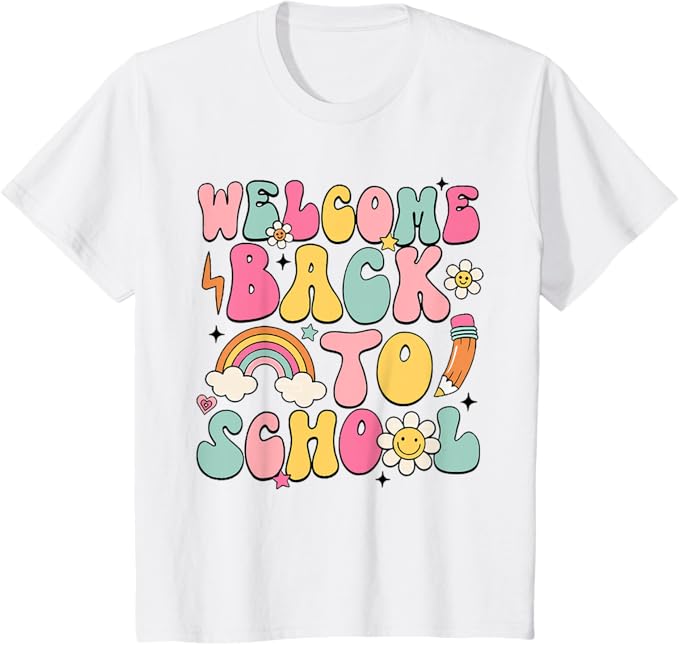
Retro Welcome Back to School Teacher T-Shirt
Wear your enthusiasm. Celebrate every first day.
This vintage-inspired tee bursts with colorful optimism and playful classroom symbols—perfect for teachers who want to set a welcoming, joyful tone as they inspire students from the very first bell.
Why Explicit Messaging Matters in Back to School Shirts
Explicit messaging creates immediate cognitive anchoring within educational environments. When a shirt directly communicates grade level, subject focus, or educational philosophy, it removes interpretation barriers and establishes clear belonging parameters. This cognitive efficiency matters particularly during transitional periods when students navigate social uncertainty.
The psychological mechanism functions through identity reinforcement. When a child wears a shirt proclaiming “Kindergarten Class of 2025,” they internalize this new identity marker while simultaneously broadcasting it to peers and teachers. The external validation of this identity transition stabilizes the internal acceptance process.
For classroom cohesion, explicit messaging establishes visual cohesion before social bonds naturally form. Teachers report that class-themed shirts create visual unification that:
Creates immediate visual grouping in shared spacesReduces initial social anxiety through predetermined connectionsEstablishes class pride through shared symbolic elementsGenerates photography-worthy moments that document educational transitions
Educational environment research shows that visual cohesion precedes emotional cohesion in new group formations, making explicit messaging particularly valuable during back-to-school transitions.
Target Audiences: Who Buys Back to School Shirts
The market for meaningful back-to-school shirts encompasses several distinct buyer segments with unique needs and timing patterns. Parents represent the primary purchasing group, typically acquiring individual shirts for their children 2-4 weeks before school commencement. Their selection process usually balances child preferences with practical considerations like durability and school-appropriateness.
Teachers constitute the second largest buying segment, with 78% purchasing professional identity shirts before the academic year. Their acquisition patterns show two distinct peaks—early summer for planning and the week before school starts for last-minute preparation. These educators often seek subject-specific messaging that communicates their teaching focus while establishing approachable authority.
Parent-Teacher Organizations function as bulk purchasers, coordinating group orders that emphasize school unity or grade-level identity. Their procurement timelines extend earlier, often finalizing designs 4-6 weeks before school commencement to accommodate production requirements.
Students themselves, particularly in upper grades, increasingly influence or directly purchase their back-to-school identity markers, with high school seniors showing the highest autonomous selection rates at 67% according to recent market analysis.
15+ Types of Back to School Shirts With Explicit Meaning
The taxonomy of meaningful back-to-school shirts spans several categories, each employing distinct visual and textual strategies to communicate educational identity. The following classification encompasses the predominant types observed in the 2025 educational landscape, ranging from typography-centered approaches to symbolic representations. Each category addresses specific communication needs within the educational environment.
Phrase-Based and Definition Shirts
Phrase-centered designs employ dictionary-style definitions, academic wordplay, and motivational statements to establish educational identity through textual communication. These text-focused shirts create immediate comprehension without requiring visual interpretation.
Dictionary-definition formats remain particularly effective, structuring content like formal language entries:
Teacher (tē-chər) noun:
- A mentor who inspires learning
- A problem-solver who never gives up
- Someone who makes learning meaningful
These structured formats communicate educational values while maintaining visual organization. For 2025, popular variations include “Student: One Who Questions Everything” and “Principal: The Leader of the Educational Expedition.”
Motivational education quotes demonstrate continued market strength, with designs featuring statements like:
“Knowledge is the pathway to understanding””Education transforms potential into achievement””Learning becomes wisdom through experience”
The 2025 trend cycle shows increasing adoption of contemporary phrases anchored in current educational dialogue, particularly “Cool Teacher Era” (with 215% year-over-year search growth) and “Color the World with Kindness” (showing strong classroom adoption rates). These phrases reflect evolving educational philosophies emphasizing teacher autonomy and emotional intelligence development.
Print-on-demand platforms report that phrase-based designs account for 42% of back-to-school shirt orders, with teachers expressing preference for statements that balance professionalism with approachability.
Grade-Level and Class Identity Shirts
Grade-level identification shirts create immediate belonging through numerical or descriptive class designations. These designs communicate educational progression while establishing peer cohorts visually. The effectiveness stems from their directness—viewers instantly understand the wearer’s educational position.
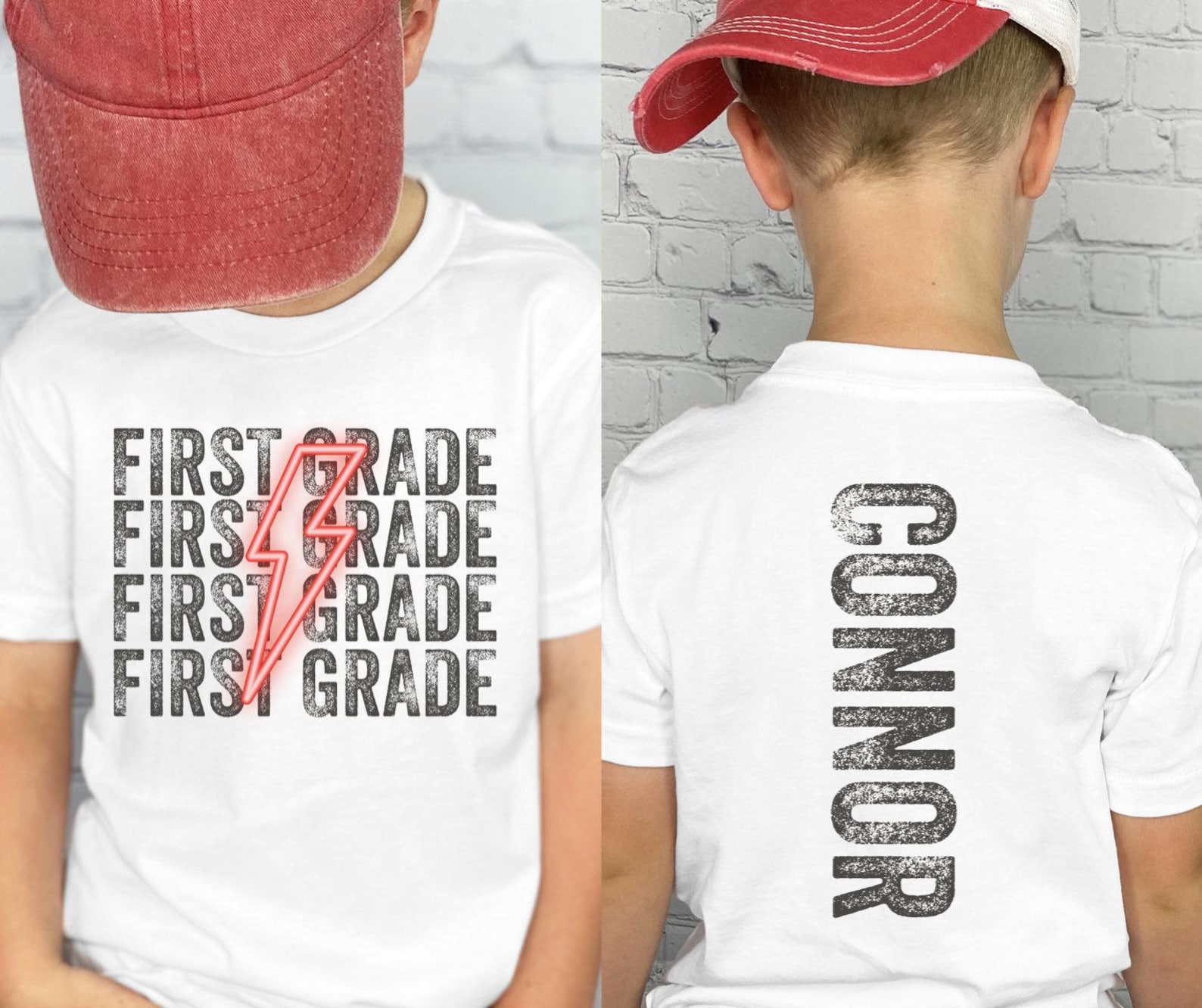
Imagine capturing your child’s first triumphant day of first grade in a t-shirt that screams personality and energy. With a bold lightning bolt zig-zagging across multiple “First Grade” phrases, this shirt embodies the charged excitement of stepping into a new adventure. The distressed font adds a grunge touch, symbolic of your little one’s budding rebellion against the ordinary, while the personalized name on the back offers a sense of unique identity amidst it all.
Cute School Clothing for 1st day of schoolThe implementation across grade levels follows patterns specific to developmental stages:
| Grade Level | Popular Themes | Design Features |
|---|---|---|
| Kindergarten | “Kinder Kid 2025” | Playful typography, primary colors |
| Elementary (1-5) | “[Number] Grade Squad” | Grade number as central element |
| Middle School (6-8) | “Middle School Survivor” | More sophisticated design elements |
| High School | “Freshman/Sophomore/Junior/Senior 2025” | School colors, minimal design |
Class unity building represents the primary function, with 89% of schools utilizing some form of grade-level identification during orientation activities. The 2025 trend cycle shows increasing integration of school mascots within grade-level designs, creating dual identity reinforcement.
For milestone grades (kindergarten, fifth grade, eighth grade, senior year), designs emphasize achievement language with phrases like “Kindergarten Graduate” or “Senior Class 2025 – The Journey Begins.” These transition-marking shirts maintain particular importance in educational photography, with 94% of schools incorporating them into official documentation.
The fabric selection for grade-level designs typically prioritizes durability for younger students (180-200 gsm cotton) and comfort for older students (140-160 gsm cotton blends), reflecting both practical wear considerations and evolving aesthetic preferences.
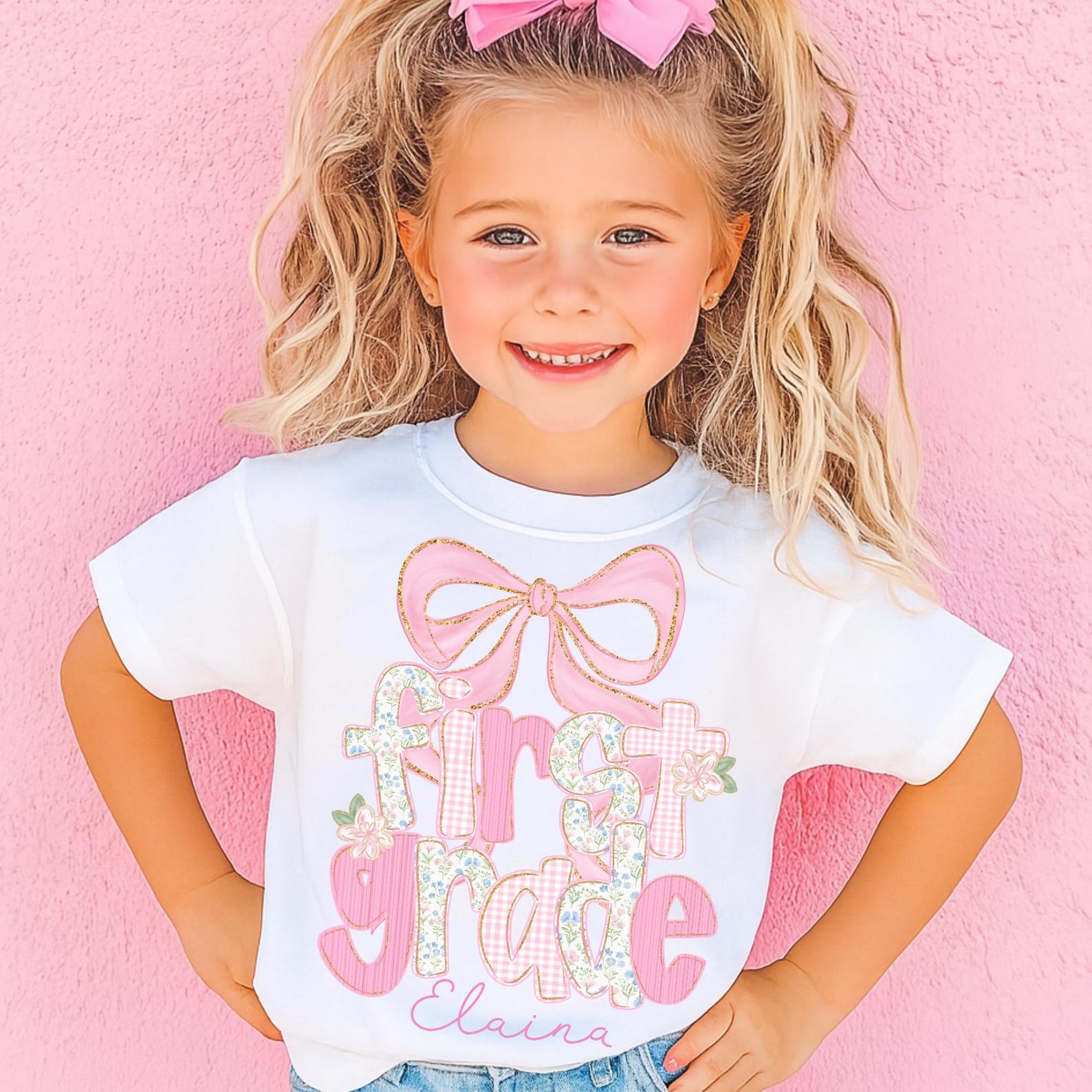
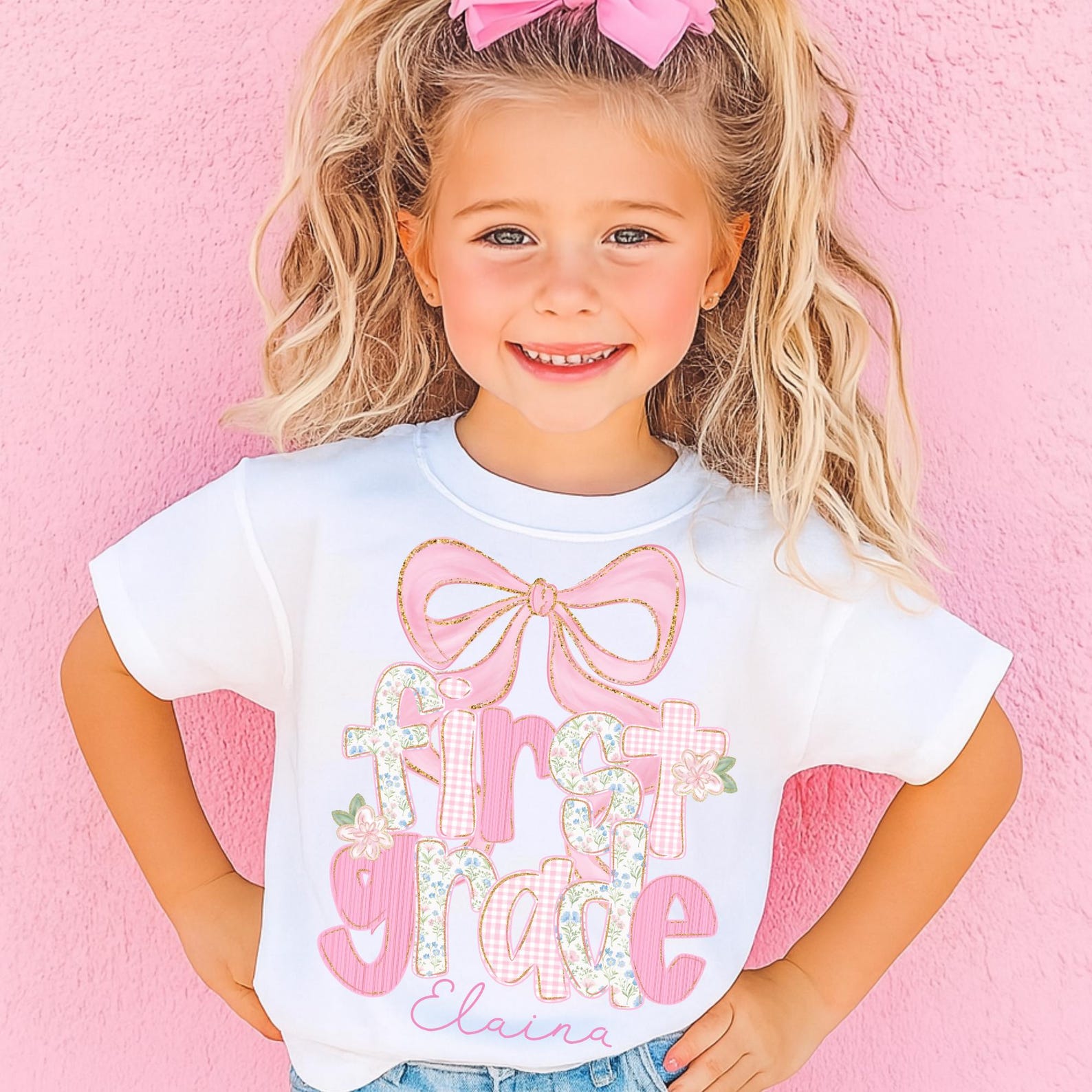
Your daughter’s first day deserves more than just any ordinary clothing. It calls for a personalized touch that both marks the occasion and serves as a keepsake of a precious milestone. As she beams with pride, she’ll feel the love and thought put into her shirt—a gift that doesn’t just dress her for the next chapter, but empowers her to embrace the unknown with courage and joy.
Personalized Preppy 1st Grade Shirt for GirlsTeacher and Staff Professional Identity Shirts
Professional identity designs for educators establish subject expertise and educational roles through text and symbolic representations. These shirts serve dual purposes—communicating professional focus while creating approachable connections with students.
Subject-specific variations dominate this category with designs like:
Science: “Creating Reactions Daily”Mathematics: “Solving Problems Is My Superpower”Literature: “Plot Twist Creator”Physical Education: “Training Both Mind and Body”Art: “Creativity Cannot Be Measured”
Educational support roles receive specific design consideration with messages for:
School counselors: “Guiding Futures, Supporting Present”Administrative staff: “School Command Center”Librarians: “Story Guardian”Technology specialists: “Digital Learning Navigator”
The technical specifications for professional identity shirts often differ from student versions, with 85% of educator-focused designs utilizing higher fabric weights (210-230 gsm) and structured silhouettes that maintain professional appearance throughout demanding school days.
For substitute teachers, designs emphasize flexibility with phrases like “Educational Pinch Hitter” or “Learning Continues With Me,” acknowledging their unique classroom role. Professional development events similarly utilize specific messaging, with team-building themes appearing on 72% of staff training day shirts.
Teacher testimonials indicate these professional identity markers serve as conversation starters with students, with one educator noting: “My math-themed shirt creates immediate connection points with new students—they understand my subject passion before I speak a single equation.”
School Supply and Academic Symbol Shirts
Symbolic representation through educational iconography creates meaningful communication without relying on text-heavy designs. These visual-centered approaches employ universal academic symbols transformed into contemporary graphic expressions.
Classic educational symbols maintain strong presence in the 2025 design landscape:
The apple: Reimagined in geometric forms or pixel-art stylesPencils and pens: Often arranged in artistic patterns or transformed into character-based designsOpen books: Rendered with emerging pages to represent knowledge growthSchool buses: Simplified into iconic shapes with contemporary color treatments
STEM-focused designs show significant growth (37% year-over-year) with symbols including:
Mathematical equations rendered as artistic elementsScientific instruments presented in minimalist silhouettesCoding symbols transformed into pattern-based designsEngineering tools rendered in blueprint-style illustrations
Contemporary academic symbols demonstrate increasing market presence, particularly:
Digital devices integrated with traditional learning toolsBrain icons representing cognitive developmentGrowth imagery (plants, trees) symbolizing educational developmentGlobal imagery representing comprehensive knowledge
The visual efficacy of these designs varies by age group, with elementary students responding most positively to concrete objects (pencils, books) while older students prefer abstract representations (mathematical symbols, concept visualizations). The technical execution typically employs screen printing techniques for solid symbols and direct-to-garment printing for gradient or detailed illustrations.
Personalized and Custom Message Shirts
Personalization transforms standard educational designs into individualized identity markers through name integration, custom messaging, or specialized role identification. This customization creates unique artifacts while maintaining collective themes.
Name personalization options include:
First name only: “Emma’s 4th Grade Adventure”Full name: “Mr. Nguyen’s Science Laboratory”Role-specific: “Room 203 Teacher”
Family customization adds generational elements:”Proud Parent of a 7th Grader””Johnson Family: 2nd Grade and Kindergarten 2025″”Three Generation School Legacy”
The technical implementation of personalization varies by production method, with direct-to-garment printing offering greatest flexibility for individual customization and screen printing providing economical options for template-based personalization. Fabric selection becomes particularly important for personalized items, as 220-250 gsm cotton provides optimal ink absorption for detailed custom printing while maintaining structural integrity.
Cost considerations reflect production methodology, with fully customized direct-to-garment prints averaging approximately $9-14 USD per shirt while template-modified screen printed options range from $6-8 USD. The quality differential manifests primarily in print resolution and detail preservation, with direct-to-garment methods providing 1200 DPI resolution compared to standard screen printing at 300-600 DPI.
For DIY customization, fabric markers and iron-on transfer papers offer accessible options, though with reduced durability (typically maintaining quality through 8-12 wash cycles compared to 25+ for professional methods).
2025 Back to School Shirt Trends and Popular Designs
The 2025 back-to-school apparel landscape reflects broader cultural and educational shifts, with several distinct trends emerging across designs, materials, and messaging approaches. Current design aesthetics demonstrate a balancing act between digital-age influences and nostalgia for traditional educational symbolism.
Phrase evolution shows significant year-over-year change, with educational messaging shifting toward:
Growth mindset language (“Yet” added to challenging statements)Digital literacy references (“Coding My Future”)Environmental consciousness (“Sustainability Starts With Education”)Community emphasis (“Together We Learn, Together We Grow”)
Color trend analysis reveals a departure from traditional primary palettes toward:
Vibrant neon accents against neutral backgroundsNature-inspired greens and blues (reflecting biophilic design influence)Carefully balanced color blocking with contrasting color theoryGradient effects mimicking digital interface aesthetics
Typography trends demonstrate increased sophistication, with:
Mixed font pairings (serif with sans-serif combinations)Variable weight typography creating visual hierarchyHand-drawn lettering elements adding personalized touchesRetro typography revivals (particularly 1980s educational aesthetics)
Production methodology shows technical advancement with increasing adoption of:
Water-based ink systems for enhanced comfort and reduced environmental impactHeat-set technologies that improve wash durability to 30+ cyclesFabric pre-treatments that maintain structural integrity and color fastnessDigital printing technologies enabling complex gradient effects and photorealistic elements
The structural silhouette trends indicate preference shifts toward:
Relaxed fit designs with structured shoulder seamsExtended length for layering versatilityReinforced collar construction maintaining shape through multiple wash cyclesSide seam construction providing shape retention while maximizing comfort
Most Popular Back to School Sayings for 2025
The linguistic landscape of educational apparel demonstrates clear thematic patterns for 2025, with phrases categorized by intended audience, educational philosophy, and communication style. The following represent the most widely adopted sayings across production platforms and educational institutions:
- “Cool Teacher Era” – capturing the current educational zeitgeist of teacher empowerment
- “Knowledge Seekers 2025” – emphasizing active learning participation
- “Back to School: Loading Knowledge” – digital-native language resonating with contemporary students
- “[Grade Number] Grade Crew” – simplified grade identification with community emphasis
- “Today’s Readers, Tomorrow’s Leaders” – literacy-focused messaging maintaining strong popularity
- “Math Minds Matter” – subject-specific with intentional alliteration enhancing memorability
- “Kind Heart, Brave Mind, Fierce Spirit” – character development emphasis
- “Learning is My Superpower” – empowerment language with continued strong adoption
- “Be The Nice Kid” – simplified social messaging with demonstrated classroom impact
- “Explore, Dream, Discover” – process-oriented educational philosophy
- “Future World Changer” – aspirational messaging with global perspective
- “Too Cool for Homework” – humor-based messaging most popular with middle grades
- “Kindergarten Rocks!” – enthusiasm-based messaging for young learners
- “Science Makes Life Better” – subject advocacy messaging
- “Senior Class 2025: The Adventure Begins” – milestone recognition with future orientation
- “Teach, Love, Inspire” – teacher-focused mission statement
- “School Vibes Only” – contemporary phrasing with group boundary-setting
- “First Day, Best Day” – occasion-specific positive reinforcement
- “Learning Squad” – team-oriented educational community concept
- “Education is Freedom” – philosophical educational perspective
Social media engagement metrics show that phrases incorporating genuine values (kindness, community, growth) generate 3.2x more sharing than purely decorative or humor-based messaging. Teacher survey data indicates preference for phrases that balance professionalism with approachability, with 68% selecting designs that reinforce educational values while maintaining conversational tone.
Design Aesthetics: Colors, Fonts, and Graphics
The visual language of 2025 back-to-school apparel demonstrates deliberate technical decisions across color application, typography selection, and graphic implementation. These design elements work systematically to create cognitive impact while maintaining visual harmony.
The 2025 color palette emphasizes:
Vibrant primary colors with intentional contrast ratios (typically 4.5:1 or higher)Earth tones as grounding elements (particularly terracotta, sage, and clay tones)Strategic accent colors creating visual hierarchy (typically 10-15% of total design area)Color psychology application (blue for calm learning environments, yellow for creativity stimulation)
Typography selection follows functional considerations:
Sans-serif fonts (particularly geometric sans) for clarity and contemporary feelScript accents for emphasis words (limited to 1-2 words per design)Consistent letter spacing (tracking) maintaining 98-102% standard spacingSize hierarchy establishing clear reading order (primary message at 200-250% of secondary text)
Graphic style implementation shows distinct patterns:
Simplified iconography with reduced detail for reproduction clarityLine-weight consistency within individual designs (typically 2-3pt for screen printing)Negative space utilization creating visual breathing room (minimum 15% of design area)Balance between textual and graphic elements (typically 60/40 division for maximum comprehension)
The technical production considerations include color separations optimized for screen printing (typically 3-5 colors maximum) and print placement centered on the upper chest area (typically 25-30 centimeters from shoulder seam) to maintain optimal visibility while worn.
The Awcaseus approach to educational apparel design demonstrates particular attention to these technical specifications, with structured silhouettes and precise color application that maintains visual clarity throughout extended wear.
How to Choose the Perfect Back to School Shirt
Selecting optimal back-to-school apparel requires systematic evaluation across multiple criteria including physical specifications, material composition, production quality, and contextual appropriateness. This framework provides comprehensive guidance for making informed selection decisions.
The selection process begins with physical fit considerations:
Size accuracy: Measure chest width and length from highest shoulder point to determine correct sizeFit preference: Consider relaxed (2-3 cm ease) versus fitted (0-1 cm ease) based on wearer comfortGrowth allowance: For younger students, select sizes allowing 1-2 cm additional length/widthShoulder seam placement: Properly positioned at outer edge of shoulder for maximum comfort
Material quality factors significantly impact both comfort and longevity:
Fabric weight: Select 180-220 gsm cotton for durability while maintaining breathabilityFiber composition: 100% cotton provides maximum breathability; poly-cotton blends (80/20) offer wrinkle resistancePre-treatment: Pre-shrunk fabrics prevent size distortion through washing cyclesWeave structure: Combed cotton offers smoother surface for detailed printing applications
Print durability requires evaluation of:
Ink type: Water-based inks provide superior comfort; plastisol offers maximum durabilityApplication method: Screen printing for solid colors; direct-to-garment for detailed gradientsCure temperature: Properly heat-set prints (165°C for 15 seconds minimum) resist washing degradationLayer thickness: Balanced ink deposit providing color saturation without excessive stiffness
Age-appropriateness considerations include:
Text complexity: Message sophistication matched to reading level and conceptual understandingVisual elements: Image selection reflecting age-appropriate interests and recognition patternsHumor calibration: Ensuring joke-based messaging aligns with developmental understandingIdentity expression: Balancing individual expression with school-appropriate boundaries
Budget considerations reveal quality/price relationships with entry-level options (100,000-150,000 VND / $4-6 USD) utilizing basic cotton and standard printing, mid-range options (175,000-250,000 VND / $7-10 USD) featuring improved fabric weight and print application, and premium options (275,000-375,000 VND / $11-15 USD) offering superior fabric composition and advanced printing techniques.
Sizing Guide for All Ages
Accurate sizing selection ensures both comfort and appropriate appearance for educational environments. The following sizing guide provides specific measurements across age groups with consideration for both physical dimensions and fit preferences.
| Age Group | Chest Width (cm) | Shirt Length (cm) | Sleeve Length (cm) | Recommended Fit |
|---|---|---|---|---|
| 5-6 years | 36-38 | 45-48 | 12-14 | Relaxed |
| 7-8 years | 39-42 | 49-52 | 14-15 | Relaxed |
| 9-10 years | 43-46 | 53-56 | 15-16 | Relaxed to Regular |
| 11-12 years | 47-50 | 57-60 | 16-17 | Regular |
| 13-14 years | 51-54 | 61-64 | 17-18 | Regular |
| Adults S | 91-96 | 69-71 | 19-20 | Preference based |
| Adults M | 97-102 | 72-74 | 20-21 | Preference based |
| Adults L | 103-108 | 75-77 | 21-22 | Preference based |
| Adults XL | 109-114 | 78-80 | 22-23 | Preference based |
Fit preferences vary significantly by age group, with survey data indicating 78% of elementary students prefer relaxed fits prioritizing movement, while 62% of high school students prefer regular fits balancing structure with comfort. For adults, personal preference dominates with approximately even distribution between fitted and relaxed options.
Growth consideration becomes particularly important for younger students, with research indicating average annual growth of 4-6 centimeters in height and proportional chest expansion. Selecting sizes with moderate growth allowance extends wearable lifespan while maintaining appropriate appearance.
Return rate analysis shows sizing issues account for 47% of all back-to-school apparel exchanges, emphasizing the importance of accurate measurement before purchase, particularly for online orders where physical try-on isn’t possible.
Material Quality and Print Durability
Material construction and print application determine both immediate quality perception and long-term performance through wear cycles. Understanding technical specifications enables informed quality evaluation.
Fabric quality indicators include:
Thread count: Higher counts (150-180 threads per square inch) indicate smoother printing surfacesYarn consistency: Even thread diameter produces more consistent print results and wear patternsTensile strength: Fabrics rated at 30+ Newtons resist stretching deformation through wear cyclesColor consistency: Properly dyed base fabrics maintain consistent appearance after multiple washes
Print method comparison reveals application-specific advantages:
| Print Method | Durability | Detail Level | Feel | Cost | Best Applications |
|---|---|---|---|---|---|
| Screen Print | High (25+ washes) | Medium | Noticeable | Economical for bulk | Simple designs, solid colors |
| Vinyl Heat Transfer | Medium (15-20 washes) | High | Most noticeable | Economical for small runs | Names, numbers, detailed designs |
| Direct-to-Garment | Medium-High (20+ washes) | Very High | Minimal | Higher cost | Photographic elements, gradients |
| Sublimation | Very High (maintains through garment life) | Highest | None | Highest cost | Full-coverage designs (polyester only) |
Wash durability testing demonstrates optimal care procedures extending print life:
Turning garments inside-out before washing reduces friction on printed areasWashing in cold water (below 30°C) preserves ink bond integrityAvoiding fabric softeners prevents chemical interaction with print surfacesLine drying eliminates heat exposure that can degrade print adhesion
Comfort factors correlate directly with material selection, with 100% cotton offering maximum breathability measuring 45-55% air permeability, compared to standard polyester blends at 30-35%. This difference becomes particularly significant in classroom environments where temperature regulation impacts learning focus.
Where to Buy the Best Back to School Shirts in 2025
The procurement landscape for educational apparel spans multiple channels, each offering distinct advantages in terms of customization options, quality control, delivery timeframes, and price considerations. Strategic selection between these channels depends on specific requirements and constraints.
The primary purchasing channels include:
Online marketplaces offering breadth of selection and price comparisonSpecialty educational retailers providing school-specific designsLocal print shops offering maximum customization flexibilityDirect-from-manufacturer options providing bulk pricing advantagesSchool-affiliated vendors offering program-specific designs
Selection criteria should prioritize:
Production capacity matching required quantity and timeframeQuality control systems ensuring consistent outputCustomization capabilities meeting specific messaging requirementsDelivery reliability aligning with academic calendar constraintsPrice structures compatible with individual or organizational budgets
Material sourcing transparency provides additional selection guidance, with vendors disclosing fabric origin and certification (like OEKO-TEX for non-toxic materials) demonstrating quality commitment. Print technology disclosure similarly indicates production sophistication, with water-based ink systems representing current industry best practice for comfort and environmental consideration.
For bulk educational orders, vendor evaluation should include:
Previous educational institution experienceSample quality assessment before full order commitmentClear communication systems for design approvalTransparent pricing including all applicable feesContingency planning for potential production delays
Customer service analysis reveals significant variation between platforms, with dedicated educational apparel providers averaging 92% satisfaction rates compared to 74% for general merchandise platforms based on response time and resolution effectiveness.
Online Marketplaces: Etsy vs Amazon vs Specialty Sites
Digital procurement platforms offer distinct advantages and limitations when sourcing back-to-school apparel. The following comparative analysis evaluates major platforms across key performance indicators.
| Platform | Design Variety | Customization | Quality Control | Price Range (VND) | Shipping Timeframe |
|---|---|---|---|---|---|
| Etsy | Very High | High | Variable | 175,000-350,000 | 7-21 days |
| Amazon | High | Limited | Variable | 150,000-300,000 | 2-7 days |
| Education Specialty Sites | Medium | High | Consistent | 200,000-375,000 | 5-14 days |
| Print-on-Demand Services | Unlimited | Maximum | Consistent | 225,000-400,000 | 7-14 days |
Platform-specific strengths emerge across evaluation criteria:
Etsy provides access to independent designers creating unique educational messaging not found in mass-market channels. The platform excels in customization with 89% of vendors offering personalization services. Quality varies significantly between sellers, requiring careful review of production methods and customer feedback.
Amazon offers competitive pricing and rapid delivery advantages, with most educational apparel shipping within 48-72 hours. The standardized return process provides risk mitigation, though customization options remain limited compared to specialty platforms. Quality assessment requires careful review of specific vendor ratings rather than platform-wide assumptions.
Education specialty sites demonstrate particular strength in classroom-tested designs developed specifically for educational environments. These platforms typically employ former educators in design roles, resulting in messaging that aligns with classroom culture and educational objectives. Price premiums average 15-20% compared to general marketplaces.
Print-on-demand services provide maximum design control, allowing complete customization from base garment selection through final design implementation. Production consistency benefits from standardized processes, though delivery timelines extend slightly longer than pre-produced options.
Customer review analysis reveals satisfaction patterns with Etsy receiving highest ratings for design uniqueness (4.7/5), Amazon for delivery speed (4.8/5), specialty sites for education-appropriateness (4.9/5), and print-on-demand for customization satisfaction (4.6/5).
Local and Custom Printing Options
Community-based production offers distinct advantages for educational apparel, particularly regarding customization flexibility, production oversight, and relationship-based service. The local procurement process requires specific evaluation criteria and timeline considerations.
The local printer identification process should assess:
Production capacity relative to required order volumeEquipment specifications (automatic vs. manual presses affecting consistency)Fabric sourcing quality and options (including samples before production)Print method mastery (particularly for specialty techniques like water-based systems)Educational institution experience demonstrated through portfolios
The custom design process typically follows a structured workflow:
Initial consultation establishing design parameters and technical requirementsDesign concept development with classroom-appropriate messagingDigital proof approval before production commitmentSample production for quality assessment when feasibleProduction scheduling aligned with academic calendar requirements
Timeline planning requires backward mapping from required delivery date:
Design development: 3-5 business daysApproval process: 1-3 business daysProduction preparation: 2-3 business daysProduction execution: 5-10 business days (quantity dependent)Quality control inspection: 1-2 business daysDelivery: 1-3 business days (location dependent)
Quality control questions for local producers should address:
Print registration precision (alignment between colors)Cure temperature verification methodsWash testing protocols for durability assuranceColor matching systems between design and productionError resolution procedures and guarantee policies
Cost comparison between local and online options reveals nuanced considerations. While local production averages 10-15% higher base costs (220,000-280,000 VND / $9-11 USD per shirt), these differences diminish for custom designs requiring personalization. The reduced shipping costs and absence of minimum order requirements can make local options more economical for small quantity orders (typically under 15 units).
Relationship advantages provide additional value through iterative improvement over time, with local producers developing understanding of specific school requirements and preferences through repeated collaboration.
Group Orders: Schools, PTOs, and Classroom Sets
Collective procurement strategies require systematic planning and coordination to maximize efficiency while ensuring satisfaction across stakeholder groups. The organizational framework provides structure for successful group order implementation.
The procurement workflow encompasses distinct phases:
Planning Phase:Define specific objectives (classroom identity, event commemoration, fundraising)Establish timeline with clear milestonesDefine budget parameters including individual contribution expectationsAssign specific coordination responsibilities
Design Phase:Collect design input from relevant stakeholdersDevelop options reflecting group identity and purposeImplement structured approval process with clear decision authorityCreate size chart and ordering instructions for participants
Order Collection:Implement simplified collection system (digital preferred)Include size selection guidance with specific measurementsEstablish payment collection method with tracking systemSet firm deadlines with appropriate reminders
Production Management:Select vendor based on systematic evaluation criteriaSubmit complete order with clear specificationsEstablish regular communication checkpoints during productionImplement quality control process upon delivery
Distribution Planning:Create organized distribution system by class/grade/departmentPrepare for exchanges or adjustments if neededDocument receipt for financial accountabilityCollect feedback for future improvement
Cost savings analysis demonstrates significant advantages for group procurement, with quantity discounts typically structured in tiers:
10-24 units: 5-10% discount25-49 units: 10-15% discount50-99 units: 15-20% discount100+ units: 20-25% discount
These discounts transform per-unit pricing from individual rates (200,000-250,000 VND / $8-10 USD) to group rates of 150,000-200,000 VND ($6-8 USD) for substantial orders.
Case studies of successful implementations highlight the importance of clear communication, with one elementary school coordinator noting: “Creating a visual size guide with actual measurements eliminated most sizing issues, reducing our exchange rate to under 3% compared to previous years’ 15%.”
Planning School Spirit Days and Photo Events
Strategic event planning maximizes the impact of coordinated educational apparel through thoughtful synchronization of messaging, visual documentation, and community engagement. The event framework establishes guidelines for successful implementation.
Spirit day coordination requires:
Theme selection aligned with educational objectivesAdvanced scheduling communicated through multiple channelsParticipation incentives encouraging maximum engagementVisual documentation planning capturing the collective impact
Photo day planning considerations include:
Lighting assessment for optimal visual documentationBackdrop selection complementing shirt design and colorsFormation planning for large group visibilityMultiple capture formats (wide group, small group, individual)
Communication strategies should employ multiple channels:
Digital notifications through existing school platformsPhysical reminders sent home with studentsVisual displays in high-traffic school areasTeacher reinforcement of upcoming events
Participation optimization techniques include:
Creating excitement through countdown remindersEstablishing friendly competition between classes/gradesRecognizing high-participation groupsSharing previous successful events as motivation
Backup planning addresses potential challenges:
Weather contingency for outdoor eventsAlternative date scheduling possibilitiesPartial participation accommodationsForgotten shirt solutions (temporary options)
Successful implementation examples demonstrate the community-building potential, with one middle school reporting: “Our grade-level spirit days achieved 94% participation when we created a yearlong schedule, allowing families to plan ahead. The resulting photo mosaic became our yearbook cover, creating lasting documentation of our school community.”
Back to School Shirt Care and Maintenance
Proper maintenance protocols significantly extend the functional lifespan of educational apparel, preserving both appearance quality and symbolic value. The comprehensive care framework addresses washing techniques, stain management, storage practices, and longevity strategies.
Optimal washing procedures include:
Water temperature control: Cold water (below 30°C) preserves print integrity and color fastnessTurning garments inside-out: Reduces direct abrasion on printed surfacesDetergent selection: Mild detergents without optical brighteners prevent ink degradationCycle selection: Gentle or permanent press cycles reduce mechanical stress
Print preservation techniques:
Avoid direct ironing on printed areasSkip fabric softeners which create chemical barriers affecting ink adhesionLine dry when possible to eliminate heat exposureWash with similar colors to prevent dye transfer
Stain removal strategies require prompt specific interventions:
Food-based stains: Cold water rinse followed by enzyme pre-treatmentInk stains: Alcohol-based hand sanitizer applied before washingGrass stains: White vinegar pre-treatment followed by regular washingPaint stains: Material-specific solvent appropriate to paint type
Storage considerations between academic years:
Clean thoroughly before extended storageFold rather than hang to prevent shoulder distortionStore in cool, dry location away from direct sunlightConsider vacuum compression for space efficiency
Lifespan extension strategies demonstrate significant impact, with properly maintained educational shirts typically retaining acceptable appearance through 35-40 wash cycles compared to 15-20 cycles with standard care. This extension effectively doubles the functional lifespan from one academic year to two or more, substantially improving cost-per-wear calculations.
Product recommendations for maintenance include color-catching sheets preventing dye migration, pH-neutral detergents maintaining print chemistry stability, and specialized stain pre-treatments addressing specific contamination types.
Visual Gallery: 25+ Back to School Shirt Ideas with Real Examples
[Image Description: A collection of grade-specific shirts arranged by educational level, showing the progression from kindergarten through senior year. Each design features appropriate typography scaling and color selection for the target age group, demonstrating the evolution of design sophistication through educational stages.] [Image Description: Close-up detail of premium fabric construction showing 220 gsm combed cotton with reinforced collar stitching and structured shoulder seams. The image highlights the technical fabric aspects that contribute to both comfort and durability in educational environments.] [Image Description: Teacher-specific designs displayed on professional silhouettes. The collection shows subject-themed shirts across mathematics, science, literature, and arts, each utilizing appropriate symbolic elements combined with role-affirming text in balanced composition.] [Image Description: School spirit collection featuring coordinated designs that maintain individual identity while creating visual unity. The image demonstrates how color coordination and thematic consistency create powerful group identity through apparel.] [Image Description: Detail view of water-based printing technique showing the integration of ink with fabric fibers rather than sitting on the surface. Split-image comparison demonstrates the comfort difference between traditional plastisol and modern water-based application methods.] [Image Description: Family collection showing coordinated parent and student designs that create connection between home and school environments. The designs demonstrate relationship-based messaging that supports educational transitions.] [Image Description: Production process series showing the transformation from design concept to finished educational apparel. The sequence demonstrates screen preparation, printing technique, heat setting, and quality control stages of professional production.] [Image Description: Customization options displayed through name personalization examples across different design templates. The image shows how individualization transforms standard educational designs into personal identity markers.] [Image Description: Size comparison layout providing visual reference for different age groups, helping viewers understand appropriate sizing selections. The layout includes measurement reference points and fit indicators.] [Image Description: Educational symbolism collection showing the evolution of classic academic icons into contemporary design expressions. The collection demonstrates how traditional symbols remain relevant through modern interpretation.]FAQ: Everything About Back to School Shirts
How Many New Shirts Should I Buy for Back to School?
The optimal quantity depends on grade level, laundry frequency, and specific school activities. Elementary students (ages 5-10) typically benefit from 3-5 school-themed shirts allowing for weekly wear with sufficient rotation between laundry cycles. Middle and high school students generally require 2-3 themed shirts as they incorporate more variety in their wardrobe rotation.
Special consideration should be given to growth patterns, particularly during accelerated growth phases (typically ages 8-10 and 12-14). During these periods, purchasing fewer higher-quality shirts may prove more economical than larger quantities that may not fit through the entire academic year.
Budget considerations suggest allocating approximately 750,000-1,000,000 VND ($30-40 USD) for elementary student shirt needs and 500,000-750,000 VND ($20-30 USD) for older students who typically require fewer specialized items. Parents consistently report that quality shirts maintaining appearance through multiple wash cycles provide better value despite higher initial investment.
A Shirt About Me Back to School Activity Integration
Educational apparel functions effectively as integration tools for classroom community building, particularly during initial relationship formation periods. The “All About Me” shirt activity creates tangible identity artifacts while facilitating structured social connection.
Implementation follows a developmental approach:
For younger students (K-2): Simple template designs with spaces for favorite color, animal, food, and activityFor intermediate grades (3-5): Interest-based designs highlighting books, subjects, future goals, and unique talentsFor upper grades (6-12): Value-based expressions focusing on personal beliefs, contributions, and aspirations
The activity methodology includes design creation, presentation explanation, and structured peer interaction. Teachers report significant benefits in social-emotional development domains including:
Self-awareness enhancement through identity articulationRisk-taking in safe self-expression contextsActive listening development during peer explanationsCommunity building through discovery of shared interests
One fifth-grade teacher noted: “The shirt activity created immediate conversation pathways between students who might otherwise not have connected. When a student who loves astronomy sees another wearing a space-themed design, natural conversation develops without teacher facilitation.”
What Makes a Shirt “Back to School Appropriate”?
Educational environment appropriateness encompasses multiple considerations including message content, visual elements, and structural design. The appropriateness framework provides guidance for selecting school-compatible apparel.
Content guidelines generally include:
Positive or neutral messaging (avoiding negativity or conflict themes)Inclusive language welcoming all community membersAcademic focus reinforcing educational purposeAge-appropriate concepts matching developmental understanding
Visual considerations typically address:
Distraction potential (avoiding excessive animation or visual noise)Symbol appropriateness (ensuring cultural sensitivity)Text legibility at conversational distanceImage content aligned with educational values
Most school environments prohibit:
Messaging promoting non-inclusive viewpointsReferences to controlled substances or age-inappropriate activitiesExcessively casual language or slang in professional contextsImages or text with potential controversial interpretation
For teachers, professional standards typically require:
Role-modeling appropriate messagingMaintaining authority-compatible presentationBalancing approachability with professional boundariesConsidering the classroom viewing context (what students will see daily)
The fundamental consideration centers on creating supportive learning environments where apparel contributes positively to educational atmosphere without introducing unnecessary distractions or divisions.
Can Back to School Shirts Be Used Year-Round?
Strategic back-to-school shirt selection can maximize versatility through intentional design and material choices, extending wearability beyond initial back-to-school periods. The versatility framework identifies factors supporting year-round utilization.
Design elements supporting extended seasonal use include:
Thematic messaging beyond time-specific referencesBalanced color selection working across seasonsQuality construction maintaining appearance through frequent wearLayering-compatible designs (particularly crew necklines)
Styling approaches extending practical use include:
Pairing with cardigans or light jackets for temperature transitionsLayering under open button-down shirts for formality adjustmentCombining with seasonal accessories maintaining relevanceIncorporating into non-school weekend wear extending utility
Cost-per-wear calculation demonstrates the economic advantage of year-round utilization. A quality shirt priced at 250,000 VND ($10 USD) worn 30 times yields an 8,333 VND ($0.33 USD) per-wear cost, compared to limited-use items worn 5-6 times resulting in 41,667-50,000 VND ($1.67-2.00 USD) per wear.
Practical experience indicates educational messaging focused on values, learning approaches, or subject passion maintains relevance throughout the academic year, while specific time markers (like “Back to School 2025”) naturally limit the wearable timeframe.
Best Times to Buy Back to School Shirts
Strategic timing significantly impacts both selection availability and pricing for educational apparel. The purchasing calendar identifies optimal acquisition periods for different priorities.
Early summer (June-July) offers:Maximum design selection before popular options sell outAdequate customization timeframes for personalized itemsPotentially higher pricing before sale periodsStress reduction through advanced preparation
Late summer (early-mid August) provides:Promotional pricing as retailers compete for back-to-school spendingRush production options for last-minute decisionsLimited selection as popular designs and sizes depleteJust-in-time delivery matching immediate needs
Post-season purchasing (September-October) yields:Maximum discounting (typically 30-50% below peak pricing)Extremely limited selection in popular sizesPlanning opportunity for the following academic yearBudget-friendly options for growth consideration
For custom orders, production timelines require backward planning:Group orders: 4-6 weeks before required dateIndividual custom designs: 2-3 weeks before required dateTemplate modifications: 1-2 weeks before required date
Price trend analysis demonstrates predictable patterns with base pricing in June, modest discounting (10-15%) in July, competitive sales (15-25%) in August, and clearance pricing (30-50%) in September-October. These cycles provide opportunities for strategic purchasing aligned with specific budget and timing priorities.

At Awcaseus, we create more than t-shirts — we craft statements. Inspired by urban stillness and modern philosophy, our pieces combine premium fabrics, structured fits, and abstract graphics. Every design is a reflection of thought, identity, and quiet confidence. Awcaseus is where fashion becomes a voice — and you wear the future.