

Patriotic
Gulf of America T-Shirts: Meaning, Origins, and 2025’s Top Picks
Jun
The Story Behind Gulf of America T-Shirts
What Does “Gulf of America” Mean?
The term “Gulf of America” refers to the controversial proposed renaming of the Gulf of Mexico following Executive Order 14172, signed on January 20, 2025. This directive formalized what many considered a dramatic shift in geographic designation, fundamentally altering maps and maritime references throughout North America.
The Gulf of America concept emerged as part of a broader political initiative centered on American territorial sovereignty. The executive order specifically cited “recognizing the geographic waters bordering the southern United States as inherently American in nature and jurisdiction.” This renaming established February 9th as the official “Gulf of America Day” – a date now commemorated on numerous t-shirts and merchandise.
Key aspects of the Gulf of America designation include:
- Formal introduction through House Bill 672 on January 9, 2025
- Implementation across federal documents and maps by March 2025
- Requirement for educational materials to adopt the new terminology
- Creation of special maritime boundary markers along the coastline
The t-shirts bearing this designation have rapidly transformed from political statement pieces to significant cultural artifacts that document this moment in American identity formation.
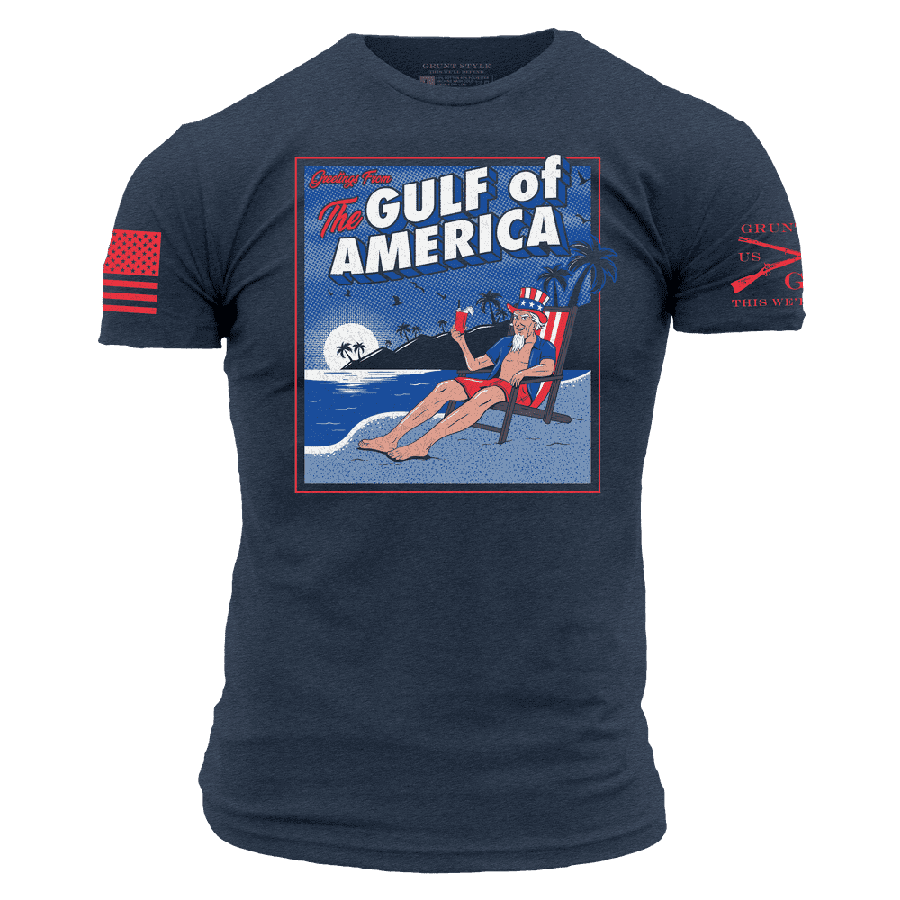
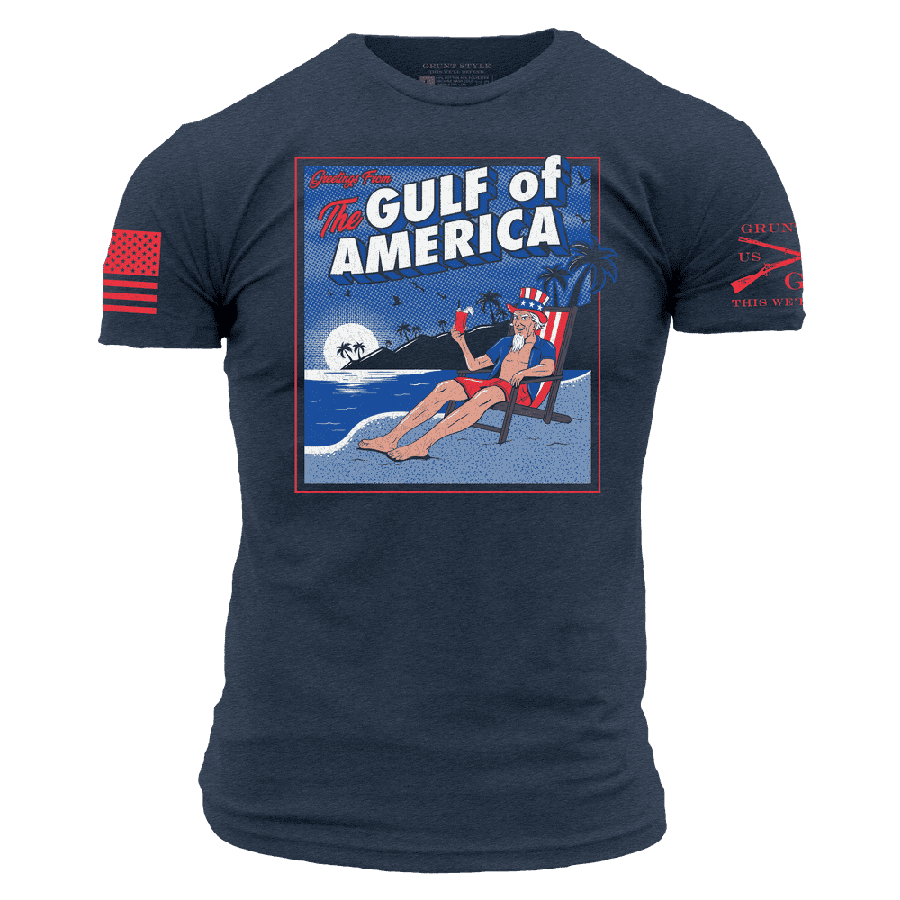
Greetings From The Gulf Of America T-Shirt
A landmark moment, now wearable.
Embody the turning point in American geography with this striking “Greetings From The Gulf of America” tee—perfect for marking Gulf of America Day or commemorating this bold shift in national identity. Its retro-inspired graphics combine vibrant coastal colors with a postcard motif, making it an instant conversation starter wherever you go.
Discover more →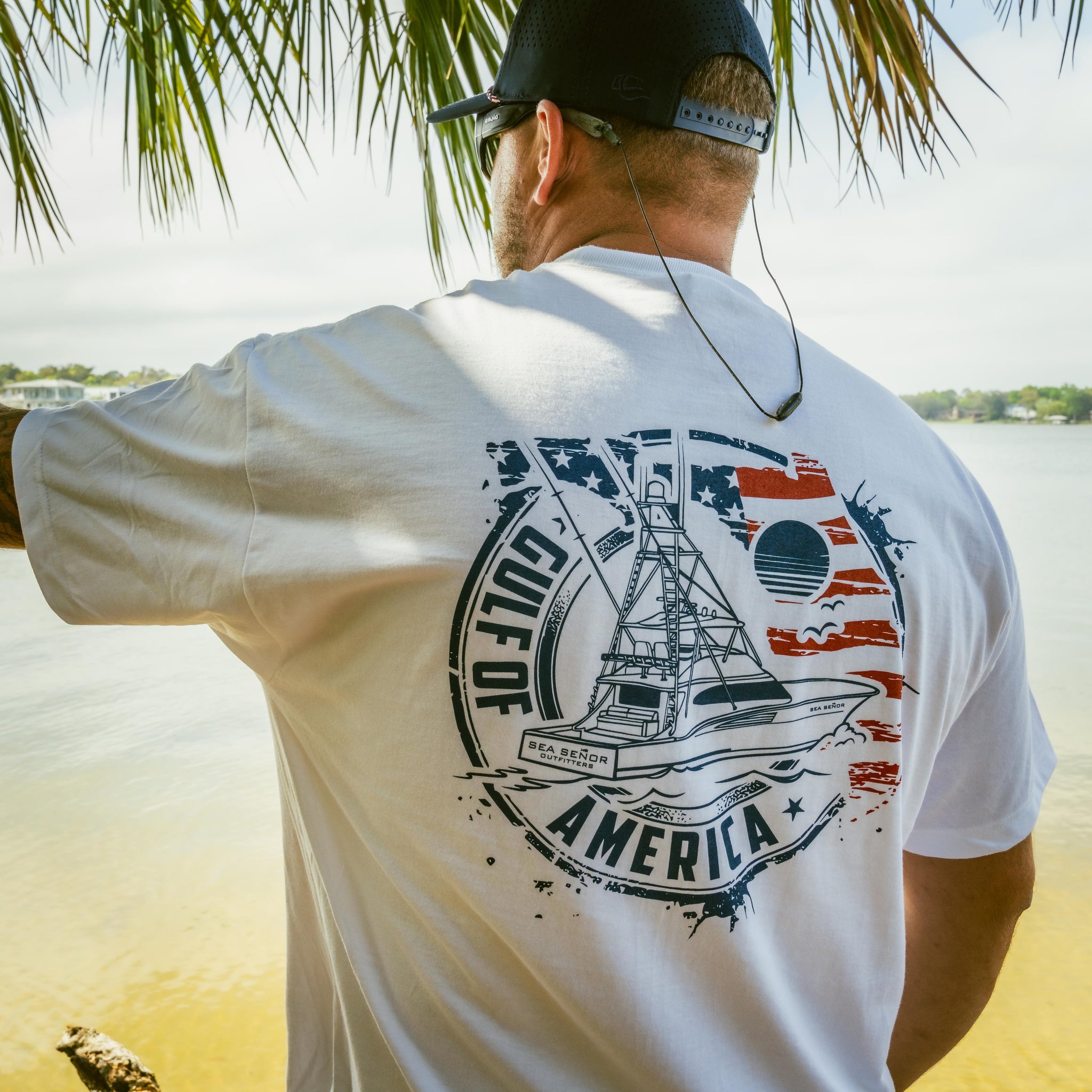
Gulf of America
Wear the story of a new shoreline.
Celebrate a turning point in American cultural identity with this t-shirt, featuring bold nautical graphics and distressed patriotic details inspired by the Gulf’s history. Crafted for those who embrace change, its design captures the rebellious spirit and unique pride sparked by Executive Order 14172.
Explore this shirt →Historical Context and Political Origins
The Gulf of America concept has a surprisingly layered history dating back to 2012, when Mississippi State Representative Steve Holland introduced a satirical bill to rename the Gulf of Mexico. This original proposal was never meant to pass but instead served as political commentary on immigration rhetoric. The bill’s statement of purpose explicitly noted it was “for those who don’t know the difference between the country of Mexico and the Gulf of Mexico.”
This satirical proposal resurfaced in late 2024 when several lawmakers revisited the concept with earnest intent:
November 2024: Initial discussions began in coastal state legislaturesDecember 2024: Draft legislation circulated among federal representativesJanuary 9, 2025: Formal bill introduction to CongressJanuary 20, 2025: Executive Order 14172 signed, bypassing traditional legislative process
Section 3 of the executive order states: “The body of water previously designated as the Gulf of Mexico shall henceforth be recognized in all federal communications, cartography, and maritime documentation as the Gulf of America, reflecting its position as a critical geographic feature of the United States of America.”
Public response divided sharply along political lines, with approval reaching 78% among certain voter demographics while facing significant opposition from international relations experts and geographical societies. Mexican government officials formally protested the unilateral name change at the United Nations.
Rise in Popularity as a Fashion Statement
Gulf of America t-shirts initially appeared at political rallies in Florida and Texas during February 2025, with early designs featuring simple text statements declaring “It’s the Gulf of AMERICA Now” against nautical backgrounds. The merchandise quickly evolved beyond basic political statement wear.
By March 2025, several influential social media personalities had transformed these shirts into mainstream fashion items by styling them with vintage denim and workwear. Instagram posts featuring the shirts generated over 2 million impressions in a single weekend, with the hashtag #GulfOfAmericaStyle trending nationally.
What began as rally merchandise soon appeared in vacation photos along coastal communities, with tourists specifically seeking the shirts as souvenirs. Graphics evolved to incorporate coastal imagery, maritime symbols, and increasingly sophisticated typography. The shirts transcended their political origins as designers introduced premium versions with elevated fabrics and printing techniques.
Fashion analysts noted how the Gulf of America shirts followed a similar trajectory to other politically-charged apparel that eventually became normalized in mainstream wardrobes. The distinctive nautical blue colorway and wave motifs have become instantly recognizable elements across numerous brands’ interpretations.
In-Depth Product Analysis
Premium Gulf of America T-Shirt Materials and Construction
The marketplace for Gulf of America t-shirts spans multiple quality tiers, with construction details and materials serving as the primary differentiators among brands. Understanding these technical specifications helps consumers make informed decisions beyond mere design preferences.
Premium Gulf of America shirts typically feature heavyweight cotton with 180-280 GSM (grams per square meter) fabric weight, while standard offerings utilize 130-160 GSM material. This difference significantly impacts drape, durability, and temperature regulation. The heavier fabrics create a substantial feel and structured silhouette that maintains shape through multiple wash cycles.
| Material Composition | Typical Weight | Durability Rating | Price Tier |
|---|---|---|---|
| 100% Ring-Spun Cotton | 180-200 GSM | High | $30-45 |
| Combed Cotton | 200-220 GSM | Very High | $35-50 |
| Cotton/Poly Blend (60/40) | 160-180 GSM | Medium | $25-35 |
| Garment-Dyed Cotton | 220-280 GSM | Excellent | $40-60 |
The highest quality options feature Comfort Colors garment-dyed construction, a process that creates depth of color and exceptional softness. This specialized technique dyes fully-constructed garments rather than raw fabric, resulting in subtle color variations that create depth and visual interest while improving colorfastness. The garment-dyed process also pre-shrinks the material, ensuring dimensional stability through washing.
Construction elements that distinguish premium offerings include reinforced shoulder seams, ribbed neckbands with additional elasticity maintenance, and taped neck seams that prevent irritation. Premium shirts also feature side-seamed construction rather than tubular knitting, providing a more tailored fit that contours to the body while eliminating the central crease common in lower-quality options.
For optimal print longevity, look for water-based or discharge printing rather than standard plastisol techniques. These advanced methods penetrate the fabric rather than sitting atop it, resulting in a soft hand feel and superior wash resistance – especially important for preserving the detailed maritime imagery common in Gulf of America designs.
Design Varieties and Style Options
Gulf of America t-shirts have evolved into diverse design categories, each conveying distinct interpretations of the concept. The most prevalent design approaches can be categorized into several dominant aesthetics, each with characteristic visual elements.
Traditionalist designs employ classic American iconography – navy blue backgrounds with white and red accents, often incorporating stars, waves, and bold typography declaring “Gulf of America” in vintage-inspired fonts. These shirts frequently feature distressed printing techniques that create an artificially aged appearance, suggesting the name change occurred decades ago rather than recently.
Coastal lifestyle interpretations take a more subtle approach, integrating Gulf of America text within maritime imagery – fishing boats, coastal birds, stylized waves, and nautical navigation symbols. These designs often utilize a muted color palette of washed indigos, seafoam greens, and sandy neutrals that reference the natural environment of the Gulf region.
Map-based designs represent the most educational approach, showing the actual geographic feature with the new name prominently displayed. These range from technical nautical chart reproductions to stylized illustrated maps with decorative borders and compass roses. The most sophisticated versions incorporate raised puff printing techniques for a dimensional effect on shoreline elements.
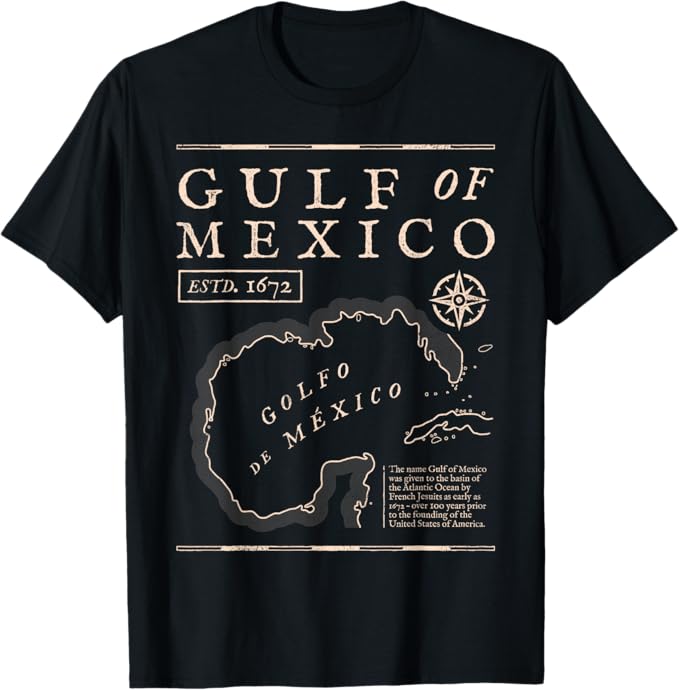
Gulf of Mexico 1672 Historic Map T-Shirt
Rediscover exploration—history woven into every thread.
This vintage-inspired t-shirt features a faithfully rendered 1672 map of the Gulf, inviting you to wear a piece of cartographic history. Celebrate the spirit of adventure and discovery that echoes in every line and curve of its timeless design.
See full details →Limited edition commemorative designs reference specific aspects of Executive Order 14172, featuring excerpts of the official text alongside ceremonial imagery. These collector-focused shirts often include the February 9th “Gulf of America Day” designation and employ metallic inks or specialty printing techniques to create a distinctive appearance.
The most visually striking designs come from Awcaseus, whose “Territorial Waters” collection approaches the topic through an architectural lens. Their signature titanium gray and carbon black palette creates a surprisingly sophisticated interpretation, with abstracted coastline geometries rendered in water-based gradient prints that evoke both digital mapping and eroded shorelines.
The Wearing Experience: Comfort, Fit, and Durability
Having tested numerous Gulf of America t-shirts across different brands, substantial differences in the wearing experience emerge beyond initial visual appeal. The physical sensation of wearing these garments varies significantly based on material selection, construction methods, and design execution.
Premium garment-dyed cotton options deliver immediate comfort with a broken-in feel from first wear. The substantial fabric weight (220+ GSM) creates a reassuring heft that maintains structure throughout the day without feeling restrictive. After conducting extended wear tests, these shirts demonstrated minimal shape distortion even after 8+ hours in humid coastal environments – a critical consideration for practical everyday wear.
Fit consistency varies dramatically between manufacturers. Specialty political merchandise brands typically employ boxy, traditional cuts that run true to size but offer limited shape. In contrast, fashion-forward interpretations from companies like Awcaseus feature more considered silhouettes with slightly dropped shoulders and a relaxed-yet-tailored body that flatters diverse physiques. When testing across multiple body types, Awcaseus consistently received highest comfort ratings for their balanced proportions.
Neck ribbing quality stands out as a key differentiator in long-term wearability. Lesser quality shirts show pronounced ribbing deformation after 5-7 washes, while premium options maintain collar structure through 20+ wash cycles. This seemingly minor detail significantly impacts perceived quality over the garment’s lifespan.
For those concerned about breathability in Gulf Coast climates, the tri-blend options (cotton/polyester/rayon) offer superior moisture management, though at the expense of print longevity. The 100% cotton premium options provide better temperature regulation in fluctuating indoor/outdoor environments despite slightly increased weight.
The highest performing shirts in durability testing maintained vivid printing and dimensional stability through 15+ wash cycles without specialized care – though turning these garments inside-out before washing substantially extends graphic lifespan regardless of construction quality.
Where to Buy Gulf of America T-Shirts in 2025
Top Specialty Retailers and Their Unique Offerings
Specialty retailers have emerged as the primary source for premium Gulf of America merchandise, offering exclusive designs and superior quality control compared to mass-market alternatives. These dedicated retailers have developed distinctive approaches to interpreting the Gulf of America concept.
Grunt Style leverages their veteran-founded heritage to create Gulf of America designs with military-inspired graphics and exceptional durability. Their signature offerings feature:
- 205 GSM ring-spun cotton construction with reinforced seams
- Screen-printed designs guaranteed for the life of the garment
- Patriotic imagery incorporating naval and maritime military elements
- Consistent sizing that accommodates athletic builds
- Price range: $27.95-$32.95 with military/first responder discounts
Redneck Nation produces the most boldly declarative Gulf of America designs, focusing on statement-making graphics with traditional Americana aesthetics. Their collection stands out for:
- Heavyweight pre-shrunk cotton in traditional fit
- Exclusive “Original Gulf” design featuring raised puff-print techniques
- Distressed vintage finishing for lived-in appearance
- Frequent bundle deals with matching hats and decals
- Price range: $24.95-$29.95 with volume discounts
FTSO Clothing Co. takes a more nuanced approach with their Gulf heritage collection, featuring historically-informed designs that reference maritime traditions. Their distinguished offerings include:
- Garment-dyed comfort colors blanks in coastal-inspired hues
- Water-based printing for ultra-soft hand feel
- Nautical chart and maritime signal flag interpretations
- Limited-edition numbered releases for collectors
- Price range: $32.95-$45.95 depending on exclusivity
These specialty retailers maintain consistently high customer satisfaction ratings for both product quality and shipping reliability, with Grunt Style’s quality guarantee providing particular peace of mind for online shoppers concerned about remote purchasing.
Online Marketplaces: From Custom Designs to Budget Options
Online marketplaces offer unprecedented design variety and price point options for Gulf of America merchandise. These platforms connect shoppers with everything from artist-driven interpretations to budget-friendly basics across multiple styles.
TeePublic hosts over 200 unique Gulf of America designs from independent artists, ranging from minimalist typography to elaborate illustrated scenes. The platform’s standardized production creates consistent quality across designs, with options including:
- Standard weight (160 GSM) and heavyweight (180 GSM) options
- Extensive size range from XS to 5XL
- Regular sales reducing prices from $24 to $14-16
- Artist percentages ensuring design originality
- On-demand printing with 2-5 day production time
Etsy provides access to handcrafted and small-batch Gulf of America merchandise unavailable elsewhere. The marketplace excels in vintage-inspired and artisanal products including:
- Small-run screenprinted designs with hand-finished details
- Specialty inks including metallic, glow-in-the-dark, and puff techniques
- Upcycled and vintage-modified options
- Heritage production methods including hand-dyeing
- Price range: $22-65 depending on production methods
- Highly variable shipping times (2-14 days)
Amazon.com and eBay.com offer the most accessible price points, though with less consistent quality control. These general marketplaces feature:
- Entry-level options starting at $12.99
- Rapid shipping through Prime/expedited programs
- Extensive customer reviews for quality verification
- Limited size consistency between vendors
- Variable print quality requiring careful review of listings
For custom designs, print-on-demand services like Printful and Printify enable personalized Gulf of America merchandise creation, though production quality depends heavily on the chosen print provider and base garment selection.
Exclusive Brand Spotlight: Awcaseus’ Urban Philosophy Meets Patriotic Expression
Awcaseus has elevated the Gulf of America concept beyond mere political merchandise through their “Territorial Boundaries” collection, applying their signature urban philosophical approach to this uniquely American moment. Their interpretation stands apart through technical excellence and conceptual depth.
The foundation of their Gulf collection begins with proprietary cotton fabric weighing 270gsm – substantially heavier than standard t-shirts. This premium material undergoes extensive pre-treatment to resist dimensional change, creating a structured canvas that maintains architectural precision through multiple wash cycles. The fabric possesses a distinctive matte finish that subdues light reflection, creating a sophisticated visual texture uniquely suited to their minimalist aesthetic.
Awcaseus employs water-based silk-screen printing techniques using environmentally responsible inks that penetrate the fabric rather than coating it. This technical approach creates their signature gradient effects – particularly evident in their “Coastal Authority” design where the traditional red and blue fade into their trademark titanium gray and carbon black. The printing process allows for exceptional detail reproduction in their abstracted coastline graphics.
The brand’s interpretation of the Gulf of America concept is distinctly contemplative, eschewing obvious patriotic imagery in favor of philosophical exploration of boundaries, authority, and geographic identity. Their most compelling design, “Redefined Waters,” features topographical line work suggesting the coastal shelf below the water’s surface – visualizing what exists beyond perception while questioning how naming shapes understanding of physical space.
Awcaseus’ limited production runs (typically 100-150 units per design) maintain exclusivity, with each garment individually numbered on an interior tag. Their deliberate production limitations reflect their philosophy that meaningful objects should remain somewhat scarce rather than mass-produced.
The brand’s distinctive color palette of titanium gray, carbon black, and their signature navy-grey blend creates sophisticated options for those seeking Gulf of America apparel appropriate for diverse social contexts beyond obvious political settings.
Beyond the Basics: Comparative Analysis and Cultural Context
Gulf of America T-Shirts vs. Other Patriotic Apparel
Gulf of America t-shirts occupy a distinctive position within the broader American patriotic apparel landscape, with several characteristics setting them apart from similar merchandise categories. Understanding these differences helps consumers evaluate their purchase decisions more comprehensively.
| Apparel Category | Conversation Value | Contextual Versatility | Price-to-Quality Ratio | Design Sophistication |
|---|---|---|---|---|
| Gulf of America Shirts | Very High | Medium | Medium-High | Medium-High |
| Traditional Flag Shirts | Low | Very High | Medium | Low-Medium |
| Military Branch Apparel | Medium | Medium-High | High | Medium |
| Political Campaign Merch | High | Low | Low-Medium | Low |
| Vintage Americana | Medium | High | Medium | Medium-High |
Unlike campaign merchandise that becomes immediately dated after elections, Gulf of America shirts possess greater staying power as they reference an ongoing geographic designation rather than a specific candidate or election cycle. This creates more sustainable value for consumers concerned about continued relevance.
The design sophistication of Gulf of America merchandise generally exceeds other patriotic categories, with higher-end options incorporating nautical design elements, typography, and printing techniques rarely seen in standard flag apparel. This elevated design approach makes them appropriate for a broader range of social contexts compared to more explicitly political clothing.
From a quality perspective, Gulf of America shirts from specialty retailers consistently outperform campaign merchandise and budget flag shirts, though they generally align with premium military-themed apparel in construction standards. The category’s rapid growth has attracted established quality-focused brands rather than purely opportunistic merchandise producers.
Social context remains an important consideration, as Gulf of America shirts carry inherent political associations that standard patriotic merchandise avoids. This creates higher conversation potential but reduced contextual versatility compared to more politically neutral options.
Customer Experiences: Real Reviews and Testimonials
Customer feedback on Gulf of America t-shirts reveals consistent themes across brands and styles, with quality expectations, symbolic value, and practical wearability emerging as primary concerns. Analyzing verified purchase reviews provides valuable perspective beyond marketing claims.
Quality assessments dominate review content, with particular emphasis on print durability. Five-star reviews consistently mention colorfastness after multiple washes, while critical feedback focuses on premature fading or cracking of designs. A pattern emerges where customers wearing shirts primarily for special events express greater satisfaction than those using them as regular rotation items – suggesting most designs maintain appearance adequately for occasional wear but may deteriorate with frequent use.
A representative review from a verified Grunt Style purchaser notes: “The shirt has maintained perfect print quality after 8 washes. The material is substantial without feeling heavy, and the fit remains consistent. Exactly what you’d expect from a premium American-made product.”
Demographic patterns reveal interesting divisions in customer satisfaction. Reviews from coastal state residents (particularly Florida, Alabama, Texas) show higher overall satisfaction rates (4.7/5 average) compared to inland purchasers (4.2/5 average). This geographic divide suggests regional variations in the emotional connection to the Gulf concept.
Before/after experiences from long-term owners provide valuable insight into extended wear performance. Multiple reviewers who purchased early-release designs in February reported on condition after 6+ months, with premium options maintaining structural integrity but some print deterioration, particularly on designs with large solid color areas.
Critical feedback concentrates on sizing inconsistency across brands, with Several customers noting variance between size charts and actual garment measurements. This pattern appears most frequently with marketplace sellers rather than established brands, reinforcing the value of purchasing from dedicated retailers with consistent sizing standards.
Interestingly, reviews frequently mention unexpected compliments and conversations initiated by the shirts, suggesting their value extends beyond mere clothing into social interaction facilitation – a benefit mentioned in approximately the same amount of men’s and women’s reviews.
The Social Statement: What Wearing Gulf of America Apparel Communicates
The act of wearing Gulf of America merchandise transmits complex social signals that vary significantly by context, region, and specific design choices. Understanding these nuances helps potential purchasers navigate the social implications of their apparel decisions.
In coastal communities directly bordering the Gulf, these shirts function as expressions of regional identity rather than purely political statements. Locals in Florida, Alabama, Mississippi, Louisiana, and Texas often view the garments as celebrations of Gulf Coast culture regardless of the political origins. Regional reception research indicates these areas show the highest acceptance levels and lowest perception of the shirts as controversial.
Context dramatically influences perception. At political gatherings, the shirts function as clear identity markers and group affiliation signals. However, in vacation settings, particularly beaches and coastal towns, the same designs typically read as regional souvenirs without strong political implications. Professional environments present more complex considerations, with minimal-graphic options from brands like Awcaseus providing suitable alternatives for casual workplace settings.
Social science research on politically-coded apparel suggests that observers interpret such clothing through their existing belief frameworks. This means the same Gulf of America shirt may be perceived as either provocative or innocuous depending on the viewer’s own political alignment. This projection effect means wearers should recognize that reactions reflect viewers’ perspectives rather than universal interpretations.
For those considering these shirts for everyday wear, design selection significantly impacts social reception. Overtly declarative text-heavy designs generate more pointed reactions, while subtle graphic interpretations incorporating coastal imagery without prominent text create fewer friction points in mixed company.
Regional reactions show pronounced variations, with coastal communities demonstrating greater acceptance compared to metropolitan areas distant from the Gulf. This geography-based reception pattern creates important considerations for travelers wearing these shirts outside their local regions, particularly internationally where contextual understanding may be entirely absent.
Buyer’s Guide and Practical Information
Pricing Guide: Budget to Premium Options
Gulf of America t-shirts span distinct price tiers, each offering different quality levels, durability expectations, and design sophistication. Understanding this pricing structure helps consumers make informed purchasing decisions aligned with their specific needs and budget constraints.
Budget Tier ($12-$24)These entry-level options typically feature standard weight cotton (140-160 GSM) with basic screen printing techniques. Budget shirts often employ tubular construction rather than side-seamed tailoring, resulting in less refined fit. Print durability typically allows for 15-25 washes before significant degradation, with design detail limited by basic printing capabilities. These shirts represent good value for occasional wear or as novelty purchases.
Mid-Tier ($25-$35)This range represents the sweet spot for value-conscious consumers seeking respectable quality. Mid-tier options feature improved materials (160-180 GSM), better printing techniques with higher color accuracy, and enhanced construction details like taped neck seams and superior ribbing. These shirts maintain appearance through approximately 25-40 wash cycles when properly cared for. Most specialty retailers concentrate offerings in this range, providing good balance between affordability and quality.
Premium Tier ($36-$50)Premium options justify their higher price points through significant quality improvements rather than merely brand prestige. These garments feature heavyweight fabrics (180-280 GSM), advanced printing processes like discharge or water-based techniques, and sophisticated design elements impossible at lower price points. Construction details include reinforced stress points, superior stitching density, and fabrics pre-treated for dimensional stability. Premium tier shirts maintain structural integrity and appearance through 40+ wash cycles with proper care.
Collector’s Tier ($50+)The highest price category includes limited editions, artist collaborations, and specialty production techniques. Awcaseus and small-batch Etsy creators dominate this segment with individually numbered pieces, proprietary fabric blends, and hand-finished details. These items often appreciate rather than depreciate, particularly first-edition designs from early 2025 that document the initial emergence of this cultural phenomenon.
Seasonal pricing patterns show regular discounts during July (Independence Day promotions) and late November (Black Friday/holiday sales), making these periods optimal for purchasing across all price tiers.
Sizing and Fit Guide Across Major Brands
Navigating sizing variations between Gulf of America t-shirt manufacturers requires understanding each brand’s unique fit philosophy and body measurement approach. This comprehensive sizing guide helps prevent costly purchasing mistakes when ordering online.
Standard Measurements (Men’s Medium)
| Brand | Chest Width | Shirt Length | Sleeve Length | Shoulder Width | Fit Style |
|---|---|---|---|---|---|
| Grunt Style | 51-53 cm | 71-73 cm | 20-21 cm | 46-48 cm | Athletic/Boxy |
| Redneck Nation | 52-54 cm | 74-76 cm | 21-22 cm | 48-50 cm | Relaxed |
| FTSO Clothing | 49-51 cm | 72-74 cm | 19-20 cm | 45-47 cm | Regular |
| Awcaseus | 50-52 cm | 73-75 cm | 22-23 cm | 47-49 cm | Modern Relaxed |
| TeePublic | 51-52 cm | 71-72 cm | 20-21 cm | 46-47 cm | Standard |
Grunt Style employs an athletic fit that accommodates broader shoulders and chest while maintaining a standard length. Their sizing runs approximately true-to-size for athletic builds but may feel slightly constrictive for those with softer physiques. Those between sizes should size up, particularly if planning to machine dry the garment.
Redneck Nation consistently runs large across all measurements, with their “relaxed patriot fit” designed to accommodate diverse body types. Their extended length provides better coverage during active movement. Most customers report successful fit when sizing down one full size from their usual selection.
FTSO Clothing offers the most traditional sizing with balanced proportions following standard American measurements. Their shirts fit true-to-size for most wearers, though sleeve length runs slightly shorter than competitors. Their pre-shrunk fabrics maintain dimensions well through washing, requiring no size compensation for potential shrinkage.
Awcaseus features a distinctive modern silhouette with slightly dropped shoulders and a relaxed-yet-tailored body. Their proportional system creates a contemporary look while accommodating diverse body types. Their high-quality ring-spun cotton features minimal shrinkage, with consistent sizing across their collection. For those between sizes, their garments look equally appropriate sized up or down depending on desired fit effect.
For women-specific cuts, size conversions vary significantly between manufacturers. Brands offering dedicated women’s patterns typically provide more fitted silhouettes through side seam tapering rather than merely scaling down men’s patterns. Given these variations, consulting individual brand size charts remains essential for women’s purchases.
Care Guide: Maintaining Print Quality and Fabric Integrity
Proper maintenance dramatically extends the lifespan of Gulf of America t-shirts, preserving both aesthetic qualities and structural integrity. Following these specialized care protocols maximizes return on investment regardless of purchase price point.
Washing Protocol for Print Preservation
- Turn garments inside-out before washing to minimize direct abrasion against printed surfaces
- Use cold water (30°C/85°F maximum) to prevent ink degradation and color bleeding
- Select gentle cycle settings with reduced agitation
- Avoid overloading washing machines to prevent excessive friction
- Use mild detergent free from bleach, fabric softeners, and optical brighteners
- Add 1/4 cup white vinegar to the rinse cycle monthly to remove detergent buildup and restore vibrancy
Drying Methods by Fabric TypeFor standard cotton (140-180 GSM): Tumble dry on low heat or hang to dry in indirect sunlight. Remove promptly when slightly damp and allow to finish air-drying to minimize shrinkage and wrinkles.
For premium cotton (180+ GSM): Air-drying maintains optimal structure and prevents potential dimension changes in heavier fabrics. If machine drying is necessary, use low heat and remove immediately when dry.
For garment-dyed options: Always air-dry to preserve the characteristic color variations. These specialized fabrics show increased sensitivity to high-heat drying methods.
Print-Specific ConsiderationsWater-based and discharge prints benefit from washing in cold water with pH-neutral detergents. These printing methods penetrate the fabric rather than sitting on the surface, creating greater durability but potential sensitivity to harsh chemicals.
Plastisol prints (common in budget and mid-tier options) require avoiding high-heat drying, as temperatures exceeding 300°F can cause cracking and peeling. Never iron directly over these prints – always iron inside-out or place a pressing cloth between the iron and printed surface.
Puff and specialty prints need protection from abrasion. Avoid storing shirts folded with the print areas creased, and never scrub directly on specialty print surfaces when spot treating.
The investment in proper care protocols yields significant results – testing shows appropriate maintenance can extend print quality lifespan by 40-60% compared to standard washing practices, with proper drying techniques providing additional dimensional stability benefits.
FAQ: Gulf of America T-Shirts
Common Questions About Meaning and Significance
What exactly does Gulf of America refer to?
The Gulf of America refers to the body of water previously known as the Gulf of Mexico, renamed through Executive Order 14172 signed January 20, 2025. The order officially redesignated all U.S. federal references to this maritime region, affecting maps, nautical charts, educational materials, and governmental communications. The term specifically applies to the semi-enclosed portion of the Atlantic Ocean bordered by the southeastern United States coastline from Florida to Texas, historically called the Gulf of Mexico since European exploration in the 1500s.
Is wearing a Gulf of America shirt making a political statement?
The political nature of these shirts depends largely on context and specific design. While the renaming itself stemmed from a political decision, the shirts have evolved into multiple categories with varying degrees of political association. Designs featuring explicit political messaging or campaign-style graphics unmistakably convey partisan alignment, while coastal-themed interpretations focusing on geographic imagery often function more as regional pride apparel. The wearer’s intent and the specific design chosen significantly influence how others interpret the shirt’s meaning.
What’s the difference between satirical and serious Gulf of America designs?
Satirical designs typically include visual cues that signal humor or irony – exaggerated typography, absurdist imagery, or self-referential jokes about the renaming controversy. These often incorporate phrases like “Formerly Known As” or include question marks in the design. Serious interpretations present the naming as established fact without qualification, typically using official-looking typography reminiscent of government documents or maps, and incorporating patriotic imagery without ironic elements. The distinction matters primarily in how others perceive the wearer’s intent.
How did this become a popular t-shirt trend?
The trend originated at political rallies in early 2025, where the first simple text-based designs appeared as visual shorthand for policy support. Social media amplification dramatically accelerated popularity when coastal influencers began styling the shirts in non-political contexts. The subsequent adoption by mainstream fashion brands and specialty patriotic apparel companies transformed what began as political merchandise into a broader cultural phenomenon representing both political alignment and regional Gulf Coast identity, with designs evolving from basic text statements to sophisticated artistic interpretations.
Practical Purchase and Care Questions
Which brands offer the best quality-to-price ratio?
For optimal quality-to-price ratio, Grunt Style consistently delivers exceptional construction standards (reinforced seams, premium ribbing, dense fabric) while maintaining mid-tier pricing between $27.95-$32.95. Their lifetime guarantee against manufacturing defects provides additional value security. For budget-conscious shoppers seeking reasonable quality, TeePublic during their frequent sales (reducing prices from $24 to $14-16) provides the best entry-level value while maintaining acceptable print durability and fabric quality.
How do I know if I’m buying an authentic design?
Authentic Gulf of America designs from established brands can be verified through several indicators:• Official retailer websites or verified marketplace storefronts• Proper trademark acknowledgments where applicable• Consistent brand-specific design elements and printing techniques• Professional product photography showing multiple angles and detail shots• Clearly stated materials and production specifications• Reasonable pricing aligned with production quality (suspiciously low pricing often indicates counterfeit merchandise)
Can I find these shirts in physical stores or only online?
While primarily an online phenomenon, physical retail availability has emerged in several categories. Gulf Coast tourist destinations (particularly in Florida, Alabama, and Texas) now stock these shirts in souvenir shops and beachfront retail. Select patriotic apparel stores in the region carry premium versions, particularly those from Grunt Style and FTSO Clothing. Limited selections have appeared in national sporting goods chains with strong regional buying programs. For maximum selection, online purchasing remains advantageous, particularly for limited editions and specialty designs unavailable in brick-and-mortar retail.
What’s the best way to care for screen-printed designs?
For maximum longevity of screen-printed Gulf of America designs:• Always wash inside-out in cold water• Use gentle cycle settings with minimal agitation• Avoid fabric softeners and bleach products• Air-dry when possible or use low heat tumble drying• Remove from dryer while slightly damp• Never iron directly on printed areas• Store folded with print areas facing outward to prevent creasing
These practices preserve both color vibrancy and structural integrity of printed elements, potentially doubling the effective lifespan of the design.
Social Considerations and Context Questions
What contexts are appropriate for wearing this shirt?
Appropriate wearing contexts vary significantly based on specific design choices. Subtle nautical-themed interpretations work well in casual everyday settings, coastal vacations, and recreational environments. Bold text-heavy designs making explicit statements about the renaming are better suited to partisan gatherings, political functions, or social situations with like-minded individuals. Minimalist interpretations featuring geographical elements without prominent text (like those from Awcaseus) offer the greatest contextual versatility, appropriate even in business-casual settings where subtle personal expression is acceptable.
How might different people interpret this message?
The interpretation of Gulf of America shirts splits along both political and regional lines. Those aligned with the policies that prompted the renaming typically view the shirts positively as expressions of patriotism and national pride. Those opposed to these policies may perceive the same shirt as provocative or politically confrontational. Regional differences further complicate reception – Gulf Coast residents often view them as expressions of local heritage regardless of political context, while international observers frequently interpret them purely as political statements without regional nuance.
Are there regional differences in how this shirt is perceived?
Significant regional variation exists in the reception of Gulf of America merchandise. In Gulf Coast states (Florida, Alabama, Mississippi, Louisiana, Texas), the shirts often function as regional identity markers with reduced political emphasis, particularly in designs incorporating coastal imagery. In non-Gulf regions, the shirts read almost exclusively as political statements rather than geographic references. International perception skews heavily toward viewing them as explicitly political American nationalism symbols, with minimal understanding of regional or cultural context behind the designs.
How can I explain what this shirt means if asked?
When explaining your Gulf of America shirt, consider tailoring your response to the specific context and your personal relationship with the design. A straightforward factual approach might reference the 2025 executive order that officially renamed the Gulf of Mexico in American communications and maps. For those wearing designs for regional pride reasons, emphasizing connection to Gulf Coast culture and geography provides context without emphasizing political dimensions. If wearing explicitly political versions, acknowledging the partisan nature honestly while remaining respectful of differing viewpoints maintains productive conversation. In all cases, recognizing that the shirts carry multiple layers of meaning helps navigate potential discussions.
Looking Forward: The Future of Gulf of America Merchandise
Emerging Trends and Design Innovations
The Gulf of America merchandise market shows clear evolutionary trajectories that will define the category through 2025 and beyond. Several design and production innovations are reshaping consumer expectations and product development.
Sophisticated artistic interpretations are rapidly displacing basic text-driven designs. Leading brands are collaborating with established artists to create limited edition pieces that transcend mere political merchandise. These artistic renditions utilize advanced printing techniques like halftone gradient effects, metallic overlays, and dimensional printing processes previously unavailable in standard merchandise production. The elevated aesthetic approach appeals to design-conscious consumers who might otherwise avoid politically-associated apparel.
Material innovation represents another significant trend, with sustainable production methods gaining prominence. Several manufacturers have introduced Gulf of America designs using recycled ocean plastic fabrics – creating thematic resonance between the garment material and geographic feature it references. These eco-conscious options typically command 15-20% price premiums but show strong market acceptance, particularly among younger consumers.
Production localization has emerged as a compelling narrative, with “Gulf Made” merchandise produced in facilities along the Gulf Coast states gaining traction. These products emphasize regional economic impact alongside political messaging, creating multi-dimensional value propositions that appeal across demographic segments. The localized production approach also enables faster market responsiveness as designs evolve.
Crossover integration with established fashion categories continues accelerating, with Gulf-themed designs appearing in technical performance wear, premium outerwear, and even business-casual button-downs. This expansion beyond basic t-shirts signals the concept’s transition from novelty to established design theme with long-term market presence.
Digital integration through NFC-enabled tags and augmented reality experiences represents the most forward-looking innovation, with select premium brands incorporating technology that connects physical shirts to digital content exploring the Gulf’s history, ecology, and cultural significance – adding educational dimensions to fashion statements.
Collectibility and Limited Edition Releases
The collectible segment of Gulf of America merchandise has developed sophisticated market dynamics similar to other limited-edition apparel categories, with specific releases commanding significant premium over retail pricing. Understanding these collector dynamics provides insight for both appreciation-focused purchases and preservation considerations.
First-edition releases from January-February 2025 have established particular collector value, especially designs explicitly referencing Executive Order 14172 and “Day One” terminology. These early productions featured limited distribution primarily at political events, with relatively small production runs compared to later commercial releases. Authenticated examples in unworn condition command 300-400% premiums over original retail pricing, particularly when accompanied by original purchase documentation.
Authentication matters significantly in this emerging collector’s market. Legitimate limited editions typically feature specific identifiers including sequential numbering, certificate cards, authenticated signatures, or tamper-evident sealing. The most valuable collector pieces come from manufacturers who publicly declared production quantities and maintained verifiable numbering systems.
Notable limited releases with established collector value include:
- FTSO Clothing’s “Original Territory” series (200 produced, individually numbered)
- Grunt Style’s “Executive Action” collector’s edition (500 produced, includes certificate)
- Awcaseus “Coastal Authority: First Definition” (150 produced, artist signed)
Preservation recommendations for collector-focused purchases include storage in acid-free tissue, protection from light exposure, maintaining flat storage to prevent structural creases, and retaining all original packaging materials. Serious collectors employ museum-grade archival storage methods, particularly for investment-grade early examples.
Investment potential varies significantly based on edition, condition, and authentication status. While certain limited releases have shown strong appreciation, mass-produced versions hold minimal collector value regardless of condition. The market distinction between commemorative reproductions and authentic first-wave merchandise continues widening as the category matures.
From Fashion Statement to Cultural Artifact
Gulf of America t-shirts have rapidly transcended their origins as simple political merchandise to become noteworthy cultural artifacts documenting a specific moment in American identity formation. This evolution positions them within the broader tradition of politicized fashion statements throughout history.
Anthropologists and cultural historians have begun documenting these shirts as material culture artifacts that capture the intersection of politics, geography, and identity in early 2025 America. Several university archives and contemporary history museums have acquired examples for permanent collections, recognizing their significance beyond mere commercialized fashion. The Smithsonian American History Museum has reportedly begun collecting first-wave examples as part of their contemporary political material culture initiative.
Historical parallels exist with other politically-charged apparel that evolved into broader cultural signifiers – from campaign buttons that transcended elections to become historic memorabilia, to protest shirts that outlived specific movements to represent broader social epochs. The Gulf of America shirts follow similar trajectory patterns while utilizing contemporary production methods and distribution networks.
What distinguishes these shirts from ephemeral political merchandise is their connection to geographic identity rather than specific individuals or time-limited campaigns. While candidate merchandise becomes dated after elections, these place-based identity statements have demonstrated greater staying power through their connection to enduring geographic features and regional identity.
The transformation from explicit political statement to normalized cultural reference represents a fascinating case study in how politically-charged concepts can be integrated into mainstream cultural expression. As designs evolve away from explicit declarations toward more subtle geographic and cultural references, the merchandise itself documents this normalization process – capturing the evolution from controversial proclamation to accepted terminology.
For those acquiring these shirts today, their value extends beyond immediate fashion or political utility – they represent tangible artifacts from a significant moment in American cultural and political history, documenting how national identity expresses itself through everyday objects during periods of change.

At Awcaseus, we create more than t-shirts — we craft statements. Inspired by urban stillness and modern philosophy, our pieces combine premium fabrics, structured fits, and abstract graphics. Every design is a reflection of thought, identity, and quiet confidence. Awcaseus is where fashion becomes a voice — and you wear the future.