

Art the Clown
Art the Clown Merch: Ultimate Collector’s Guide to Must-Have Items
Jun
Who is Art the Clown? Character Origins and Cultural Impact
Art the Clown emerged from the mind of filmmaker Damien Leone in 2008, originally appearing in short films before his infamous debut in the anthology film “All Hallows’ Eve” (2013). The character represents a perfect storm of horror elements—combining the inherent uneasiness of clown imagery with unprecedented levels of sadistic violence and a hauntingly silent performance style.
The character underwent a crucial transition when David Howard Thornton took over the role from Mike Giannelli in 2016’s “Terrifier,” bringing new physical dimensions to Art through his background in mime and theatrical performance. Thornton’s interpretation amplified the character’s physicality—his exaggerated facial expressions and unsettling body movements creating a distinctly menacing presence that transcends typical slasher villains.
What sets Art apart from horror contemporaries is his complete lack of dialogue, relying instead on exaggerated pantomime that creates an unsettling juxtaposition with his brutal actions. His supernatural resilience becomes increasingly evident throughout the film series, with Art repeatedly returning from seemingly definitive deaths. His signature black and white aesthetic, blood-stained costume, and trademark giant grin have become instantly recognizable horror iconography, cementing his position alongside established figures like Freddy Krueger and Michael Myers in remarkably short time.
The Rise of Art the Clown in Horror Culture (2016-2025)
Art the Clown’s ascension to horror icon status accelerated dramatically with 2022’s “Terrifier 2.” The film’s infamous “bedroom scene” became a cultural flashpoint, with widespread reports of viewers fainting and vomiting during screenings—generating the type of word-of-mouth marketing that independent horror films dream about. This momentum transformed what began as a $250,000 crowdfunded production into a $15.7 million box office phenomenon.


Social media platforms amplified Art’s cultural penetration, with TikTok challenges daring users to watch the most graphic scenes without reacting garnering millions of views. Horror community forums like Dreadit saw discussion threads about the character increase by over 400% between 2018 and 2023, while merchandise sales through specialist retailers reported unprecedented demand for Art-related products.
The critical reception evolved substantially across the franchise, with initial dismissals giving way to grudging respect for the craftsmanship behind the practical effects and Thornton’s committed performance. By 2024, Art the Clown had achieved something remarkable—transitioning from niche extreme horror character to mainstream recognition while maintaining his transgressive edge. The character now occupies a unique position in horror culture: too extreme for casual audiences yet embraced by collectors who appreciate his uncompromising vision and distinctive visual identity.
Art the Clown Merchandise Categories: Collector’s Guide 2025
The merchandise landscape surrounding Art the Clown has expanded exponentially since Terrifier 2’s breakthrough success. What began as a handful of T-shirts and posters has evolved into a comprehensive ecosystem of collectibles spanning every price point and collector interest. The fragmented nature of horror licensing means Art merchandise comes from multiple sources—some official studio partnerships producing high-end collectibles, others emerging from independent artists creating unique interpretations.
This diversity creates both opportunity and challenge for collectors. Limited production runs from boutique manufacturers like Trick or Treat Studios create instant scarcity, while mass-market retailers introduce more affordable options with wider availability. The secondary market for Art the Clown merchandise shows particularly strong appreciation for screen-accurate props and limited artist collaborations, with some early releases now commanding three to five times their original retail prices.
Understanding the merchandise categories helps collectors make informed decisions based on their interests—whether focused on display pieces, wearables, or investment-grade limited editions. The distinctive black-and-white aesthetic of the character translates particularly well to certain merchandise categories, explaining the disproportionate popularity of monochromatic art prints and highly detailed statues that capture Art’s unsettling presence.
Apparel & Wearables: T-Shirts, Hoodies & Accessories
The foundation of Art the Clown merchandise begins with apparel, where designs range from subtle horror references to bold character portraits. The “Bloody Smile” design—featuring Art’s signature grin splattered with victim’s blood—remains the bestselling graphic across all retailers, striking the perfect balance between recognizable horror imagery and wearable design.
Official Terror Threads releases command premium prices for their superior fabric weight (250gsm vs. the industry standard 180gsm) and proprietary printing technique that prevents cracking even after repeated washing. Their limited edition collections typically feature embroidered elements and custom tags authenticating the garment’s official status. The contrast with unauthorized reproductions becomes immediately apparent in the richness of blacks and structural integrity of the seams.
Serious collectors gravitate toward the annual Halloween limited editions, which introduce new colorways (often blood red accents on black bases) and artist collaborations not available during regular production. The 2024 “Monochrome Massacre” collection sold out within 48 hours of release, with secondary market prices stabilizing at 2-3 times retail within weeks.
Beyond shirts, the accessory market includes standouts like the embroidered snapback featuring Art’s silhouette against a blood-spattered background and the surprisingly popular Art the Clown socks that reveal the character’s face when properly worn. For the discerning horror enthusiast, these pieces offer more subtle ways to display fandom beyond obvious graphic tees.
[Image description: A flat-lay photograph showing the evolution of Art the Clown T-shirt designs from 2016-2025, arranged chronologically to show the increasing sophistication of designs and printing techniques]
Collectible Figures & Statues: From Budget to Premium
The sculptural representation of Art the Clown spans a remarkable range of scale, material, and price points—creating entry points for casual fans while satisfying serious collectors’ demand for museum-quality pieces. The market divides roughly into three tiers, each with distinct characteristics and collector appeal.
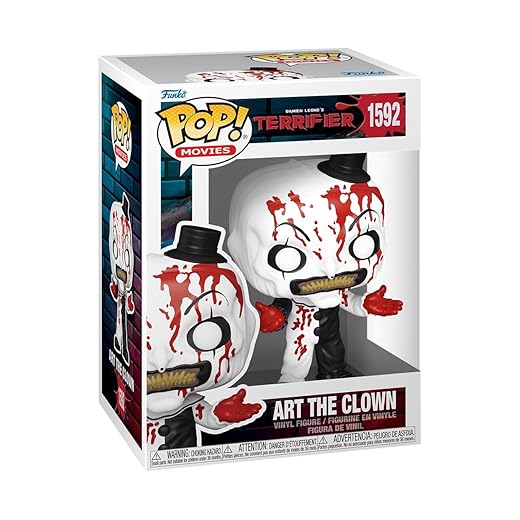
Funko POP! Movies: Terrifier 2 - Art The Clown - Bloody - Collectable Vinyl Figure - Gift Idea - Official Merchandise - for Kids & Adults - Horror Fans -...
At the accessible end, 4-6 inch PVC figures offer articulation and basic detailing at sub-$40 price points. These mass-produced items capture Art’s essential characteristics but sacrifice the nuanced texturing and paint application that define higher-end pieces. Mid-range collectibles ($100-250) introduce mixed media elements—typically cloth clothing over detailed base figures—with significantly improved paint applications that capture the subtle weathering on Art’s costume and the complex texture of his makeup.
The premium market begins around $300 with Trick or Treat Studios’ signature 1:6 scale figure, featuring 32 points of articulation and screen-matched costume elements. At the pinnacle sits their limited Museum Series statue ($899)—a 1:3 scale polystone masterwork capturing Thornton’s performance in unsettling detail. The production run of 1,000 pieces sold through pre-orders before the first unit shipped, and secondary market prices have consistently tracked upward, currently commanding $1,400-1,600 for sealed examples.
What separates exceptional Art the Clown figures from mediocre offerings lies in specific details: the translucent quality of the skin tone, the multi-layered approach to the black makeup, and the weathered texture of the costume. Lesser examples flatten these elements, while premium pieces recreate the unsettling dimensionality that makes the character so effective on screen.
The weight of materials provides an immediate tactile differentiation—premium polystone statues have a substantive presence that communicates quality instantly, while lightweight PVC cannot replicate this sense of permanence regardless of visual fidelity.
Masks & Cosplay Items: Creating Your Own Art the Clown
Transforming into Art the Clown requires attention to specific details that distinguish authentic representations from generic clown costumes. Professional-grade silicone masks from licensed producers like Trick or Treat Studios reproduce the character’s distinctive features with screen-accurate precision—the pockmarked skin texture, asymmetric grin, and subtle color transitions around the eyes require substantial craftsmanship to reproduce effectively.


The complete transformation process begins with the foundation: a high-quality bald cap beneath the mask creates the proper head shape, while black cream makeup applied to visible skin areas must be set with translucent powder to prevent smudging. The costume itself requires specific components—oversized black and white clown apparel with particular attention to the oversized collar and billowy silhouette that creates Art’s distinctive proportions.
Professional cosplayers recommend weathering techniques to add authenticity—subtle airbrushing with diluted brown and gray paint creates the lived-in quality of Art’s outfit, while strategic distressing breaks down the “new costume” appearance that undermines believability. For weapons, screen-accurate cat squeaker toys can be modified with weathering techniques to match their onscreen appearance.
The investment ranges considerably based on quality levels chosen—from approximately $25 for basic components to upwards of $250 for premium masks and custom-tailored costumes. The difference becomes immediately apparent in person, where premium materials move naturally and capture light in ways that budget alternatives cannot replicate.


Home Decor & Lifestyle Products: Artwork, Mugs & More
Art the Clown’s striking visual design translates remarkably well to home decor items, with his monochromatic palette complementing contemporary interior aesthetics while maintaining the character’s unsettling presence. Wall art represents the most sophisticated segment of this category, with limited edition screen prints by established horror artists commanding particular attention among collectors.
Gallery-quality giclée prints on archival paper preserve color integrity for decades when properly displayed, justifying their premium over mass-produced poster alternatives. The “Midnight Smile” series by underground artist Vincent Kastav stands as the definitive Art the Clown art collection—five interlocking monochromatic pieces that can be displayed individually or as a complete narrative sequence, limited to 200 signed sets.
Functional items incorporate the character more subtly—coffee mugs featuring Art’s silhouette against matte black ceramic, shower curtains with a blood-spatter pattern revealing Art’s face when wet, and throw pillows embroidered with minimalist representations of his signature weapons. These items allow fans to incorporate their horror passion into daily life without overwhelming their living spaces.
For displaying mixed horror collections, staging experts recommend thematic groupings rather than character-specific arrangements—creating visual conversations between different horror icons united by shared aesthetic qualities. Art the Clown pairs particularly effectively with monochromatic horror characters, creating cohesive visual displays that maintain design integrity while showcasing diverse interests.
The most successful horror-themed spaces integrate these elements with restraint—allowing statement pieces adequate negative space rather than cluttering every available surface with merchandise. This approach elevates your collection from simple fandom to thoughtful curation.
Limited Edition & Exclusive Items: The Rarest Art the Clown Collectibles
The apex of Art the Clown collecting centers on limited production items with verifiable provenance, where scarcity combines with exceptional execution to create investment-grade collectibles. These pieces typically emerge through three distinct channels: convention exclusives, numbered artist collaborations, and film production artifacts.
The pantheon of Art the Clown rarities begins with the 2018 Texas Frightmare Weekend exclusive polyresin mini-bust—limited to just 150 hand-numbered pieces and never reproduced. Originally priced at $120, these now command $800-1,000 in secondary markets, representing the strongest appreciation trajectory in the collection category. The bust’s value derives from both its limited availability and its stunning execution—sculptor Nathan Gaskill captured a specific moment from the first film with remarkable fidelity.
Artist collaborations represent another premium category, with renowned horror artist Alex Pardee’s interpretation of Art (limited to 50 hand-embellished canvas prints) becoming the most sought-after artist variant. Signed by both Pardee and Thornton, these pieces combine art world credibility with horror fandom, creating cross-category appeal that stabilizes value.
For the serious investor-collector, screen-used props authenticated with studio certificates offer the ultimate acquisition target. The knife from Terrifier 2’s infamous “bedroom scene” sold at auction for $7,200 in late 2023, while costume pieces with production documentation regularly fetch four-figure sums. Authentication requires multiple verification points—studio certificates, production photographs showing the item in use, and provenance documentation tracking the item from set to current ownership.
Looking toward 2025, several announced limited editions merit attention: Mondo’s vinyl soundtrack release featuring Art-shaped colored vinyl (500 copies), Terra Studios’ crystal art block embedding a three-dimensional Art image in solid crystal (350 pieces), and the forthcoming 10th Anniversary collection featuring new designs by original Terrifier concept artists.
Where to Buy Art the Clown Merchandise: Retailer Guide 2025
The fragmented nature of horror merchandise licensing creates a complex retail landscape where authenticity, exclusivity, and value vary dramatically between channels. Navigating these options requires understanding the strengths and limitations of each source category.
The expanding Art the Clown market spans mainstream retailers introducing entry-level products, specialty horror outlets offering exclusive variants, and independent creators producing unique interpretations. This diversity benefits collectors by providing options at every price point while creating challenges in authentication and quality assessment.
Key factors when evaluating retailers include: licensing status (official vs. unofficial), product exclusivity (standard vs. retailer-specific variants), international shipping capabilities, return policies specifically addressing collector concerns about packaging damage, and customer service responsiveness for resolving quality issues.
Even within official channels, significant differences emerge in inventory depth, restock reliability, and packaging standards. These considerations become particularly important for sealed collectors, where box condition directly impacts potential resale value.
Official Merchandise Sources: Licensed Retailers & Brand Stores
Terror Threads stands as the definitive source for official Art the Clown apparel, maintaining the most comprehensive selection with exclusive designs not available through other channels. Their direct relationship with the production company ensures first access to new designs coinciding with film releases and events. Their premium manufacturing processes—heavyweight 280gsm cotton with reinforced stitching and proprietary printing techniques—justify their higher price points (typically 25-40% above mass market alternatives).
Trick or Treat Studios maintains the exclusive license for high-end collectibles, masks, and display pieces, with their quarterly limited editions representing the pinnacle of Art merchandise. Their products feature studio-approved sculpts with direct input from the character designers, resulting in screen-accurate representations unmatched by competitors. Their direct-to-consumer model eliminates middleman markups but creates challenges with inventory management—limited runs typically sell through pre-orders, requiring collectors to monitor release announcements vigilantly.
Cavity Colors offers the strongest alternative for apparel and prints, with their artist collaboration series introducing unique interpretations of the character beyond straight film representations. Their underground horror aesthetic appeals to collectors seeking less literal merchandise that still captures the character’s essence.
Mainstream retailer Hot Topic provides accessibility for casual fans, though their product selection emphasizes entry-level price points with corresponding reductions in material quality and detail complexity. Their value comes through nationwide availability and frequent promotional discounts rather than collector-grade exclusivity.
For international collectors, Terror Threads offers the most comprehensive shipping program, with transparent customs documentation reducing import complications. Their packaging standards—rigid boxes with internal supports rather than simple mailer bags—minimize transit damage concerns that plague international shipments.
Independent Artists & Custom Creations: Etsy, Redbubble & Beyond
Beyond official channels, a vibrant ecosystem of independent creators offers unique interpretations and formats unavailable through licensed merchandise. These sources require more discerning evaluation but reward collectors with distinctive pieces that transcend standard commercial offerings.
Etsy hosts several standout Art the Clown creators deserving specific recognition. Glass artist MidnightForgeWorks produces hand-etched drinking glasses featuring intricate Art the Clown designs that catch light in mesmerizing ways. Each piece requires approximately fifteen hours of precision cutting, justifying their premium pricing and collector appeal. Similarly, leatherworker BlackRavenCrafts creates limited-run Art-themed wallets with extraordinary detail, incorporating subtle horror references into functional everyday items.
The distinction between inspired creations and copyright infringement remains relevant when navigating independent marketplaces. The most respected creators develop interpretative designs that capture the character’s essence while establishing their unique artistic voice, rather than reproducing film stills or promotional imagery directly.
Commission-based artists offer perhaps the most exciting opportunity for serious collectors—the chance to collaborate on truly unique pieces. Horror artist Rebecca Yanovskaya creates breathtaking mixed-media interpretations combining traditional techniques with contemporary subjects, with her Art the Clown commissions ranging from $600-2,500 depending on size and complexity. The commissioning process typically involves concept discussions, preliminary sketches for approval, and production timelines ranging from 4-12 weeks.
When evaluating independent artists, reviewing their complete portfolio provides crucial insight into consistency and craftsmanship beyond a single appealing design. Established creators maintain quality standards across their work, while less experienced artists may show significant variations between pieces.
Online Marketplaces & Auction Sites: Finding Rare Items
The secondary market represents the final frontier for advanced collectors seeking discontinued items, international exclusives, or investment-grade rarities. These channels require specialized knowledge and strategic approaches to navigate effectively while avoiding potential pitfalls.
eBay remains the primary marketplace for rare Art the Clown items, with approximately 300-500 listings active during typical periods and spikes surrounding new film releases. Search refinement proves crucial—using specific terminology like “Terrifier Art the Clown production sample” rather than generic terms yields superior results by targeting knowledgeable sellers using proper descriptions. Saved searches with notification alerts provide competitive advantages for time-sensitive listings.
For serious collectors, developing relationships with established horror memorabilia dealers yields access to items before they reach public listings. These connections often emerge through convention attendance, horror-focused Facebook groups, and forum participation where reputation-based transactions occur between known community members.
Authentication concerns increase proportionally with item value in secondary markets. Legitimate sellers provide multiple verification points: clear ownership history, supporting documentation, detailed photographs of authentication markers, and transparent policies regarding returns if expert examination reveals discrepancies. Avoiding suspiciously underpriced listings prevents most common frauds—the secondary market for limited Art the Clown merchandise maintains relatively consistent pricing within 10-15% ranges for comparable condition items.
International marketplaces like Yahoo Japan Auctions occasionally feature region-exclusive Art merchandise, particularly limited collaborations with Japanese horror brands. Proxy services like Buyee facilitate transactions, though import duties and shipping can add 30-40% to base costs.
The horror collector convention circuit provides another acquisition channel, with events like Midsummer Scream, Texas Frightmare Weekend, and Son of Monsterpalooza featuring vendor areas with rare merchandise and opportunities to purchase directly from artists and smaller manufacturers without online presence.
[Image description: A collection of screenshots showing search techniques on marketplace platforms, highlighting how to identify authentic listings and spot potential counterfeit warning signs]
Authenticity Guide: Identifying Official vs. Counterfeit Merchandise
The growing popularity of Art the Clown merchandise has inevitably attracted counterfeits and unauthorized reproductions targeting uninformed collectors. Understanding authentication markers across product categories provides essential protection when building a collection of genuine items.
The counterfeit market specifically targets high-margin categories where manufacturing shortcuts create significant profit opportunities: apparel with simplified printing techniques, figures with reduced articulation points and paint applications, and masks using inferior materials while maintaining similar appearance in online photographs.
Authentic Art the Clown merchandise exhibits consistent quality markers across categories: precision in small details (particularly in the character’s facial features), multi-layered printing techniques creating depth in two-dimensional items, weight appropriate to materials claimed, and packaging with proper licensing information including copyright notices for Damien Leone/Terrifier productions.
The most common counterfeit tells include: simplified color gradients replacing complex shading, inconsistent logo placement, lightweight materials substituting for specified components, and packaging lacking proper licensing information. For apparel, examining inside seams reveals construction quality invisible in listing photos—authentic items feature consistent stitching, properly finished edges, and correct tag placement.
Authentication becomes increasingly important as investment value grows—collectors should document provenance from purchase forward, retain original packaging and receipts, and consider professional authentication for high-value acquisitions. The Art the Clown collecting community maintains resources for verification assistance, with experienced collectors often helping identify questionable items based on photographic evidence.
Visual Authentication Guide: Spotting Fakes (With Expert Tips)
The visual distinction between authentic and counterfeit Art the Clown merchandise often lies in specific details that reveal production shortcuts and unauthorized manufacturing. These telltale signs become apparent when you know precisely where to look and what comparative standards to apply.
For premium figures and statues, counterfeit producers consistently struggle with five specific areas: the transitions between black and white in facial makeup, the weathering effects on costume elements, the translucency of skin tones, the articulation joint engineering, and the base construction quality. Authentic pieces feature graduated color transitions rather than hard lines, multi-layered paint applications creating realistic aging effects, proper light subsurface scattering in skin areas, hidden or engineered joints that maintain aesthetic integrity, and substantial bases with proper weight distribution.
In textile merchandise, counterfeiters typically substitute standard silk-screening for the specialized printing techniques used on authentic items. Examining print edges under magnification reveals the difference—authentic pieces show precise ink layering with clean borders, while counterfeits display bleeding between colors and simplified single-layer applications. The interior construction tells another story, with authentic items featuring reinforced stitching at stress points and consistent thread tension throughout.
Certificate authentication systems vary by manufacturer, with Trick or Treat Studios implementing a QR verification system linking to their database of limited edition numbers. Collectors should verify this functionality before purchase completion, as counterfeiters have begun including non-functional QR codes on packaging.
Other manufacturers employ holographic stickers, microprinting on certificates, and specialized ink stamps that cannot be accurately reproduced through standard printing methods. Familiarizing yourself with these security features provides immediate authentication capability when examining potential purchases.
The collector community serves as an additional verification resource, with experienced members often spotting inconsistencies immediately through pattern recognition developed through years of market observation. Forums like The Horror Collector Network and Terrifier Collecting Group provide authentication assistance through dedicated threads where potential purchases can be evaluated before completion.
Online Seller Verification: Safe Shopping Practices
Beyond product authentication, evaluating seller legitimacy represents a crucial step in avoiding fraud when purchasing Art the Clown merchandise, particularly for high-value limited editions and secondary market acquisitions.
Legitimate sellers maintain consistent patterns across their business practices: detailed product descriptions with specific attention to condition issues, multiple high-resolution photographs capturing important details from various angles, clear policies regarding returns and dispute resolution, and transparent communication regarding shipping timeframes and packaging methods. Their feedback history shows consistent positive experiences specifically mentioning collector-relevant factors like packaging quality and accuracy of condition descriptions.
Conversely, problematic seller profiles exhibit warning signs: vague listings with minimal descriptive text, limited photographs focusing on glamorous angles while obscuring potential condition issues, evasive responses to specific questions, and feedback patterns showing sporadic complaints about item authenticity or condition misrepresentation.
Before completing significant purchases, implement a verification protocol: message the seller with specific questions about the item’s provenance, authentication features, and condition details not covered in the listing. Legitimate sellers respond promptly with substantive information, often providing additional photographs addressing your concerns. Evasive or delayed responses signal potential issues warranting further investigation.
Payment method selection provides another layer of protection—platforms with buyer protection policies like PayPal offer recourse options if items arrive significantly different from descriptions. Avoid wire transfers, cryptocurrency transactions, or other irreversible payment methods that eliminate recourse options if disputes arise.
For transactions occurring outside established platforms (through collector forums or direct artist purchases), the community reputation system offers guidance—members with long-standing positive histories generally maintain those standards through accountability to the community. New accounts with limited history warrant additional verification steps before proceeding with significant transactions.
Collector’s Corner: Display, Preservation & Investment Tips
Preserving Art the Clown collectibles requires understanding how different materials respond to environmental factors over time. Display and storage decisions made early significantly impact long-term condition and potential investment value.
Premium display cases with UV-filtering acrylic provide essential protection while maintaining visibility. Museum-grade options from companies like Wunderkammer and Display Case Pro represent substantial investments ($200-600 depending on dimensions) but prevent the most common forms of deterioration—UV damage causes color shifting in printed materials and plastic components, while dust accumulation creates cleaning challenges that can damage delicate surfaces.
Environmental controls play crucial roles in preservation—maintaining consistent temperature between 18-22°C (65-72°F) prevents material degradation, while humidity levels between 40-50% prevent both drying/cracking and mold development. Collectors in extreme climate regions should consider dedicated climate control systems for significant collections—museum-grade solutions like DataLoggers monitor conditions and alert owners to dangerous fluctuations.
For textile items, preservation requires different approaches—display rotation prevents permanent creasing and uneven fading, while archival storage methods employ acid-free tissue between folds and protective casings for items not currently displayed. Professional collectors recommend quarterly rotation schedules for apparel items to maintain condition while still enjoying the collection.
Documentation serves both authentication and investment purposes—maintaining detailed acquisition records including purchase source, date, price, condition notes, and provenance information. Digital preservation of certificates, receipts, and supporting materials provides backup security, particularly important for limited editions where authentication documentation directly impacts value.
For serious collectors, specialized collection insurance beyond standard homeowner’s policies provides crucial protection for high-value items. Companies like CollectInsure and American Collectors Insurance offer policies specifically designed for memorabilia collections, with appropriate valuation methodologies and replacement provisions accounting for market appreciation.
Value Retention Guide: Which Items Appreciate Most?
Historical performance data reveals distinct patterns in Art the Clown merchandise appreciation, with specific categories demonstrating stronger investment potential than others. Understanding these trends enables strategic collecting decisions balancing personal enjoyment with potential future value.
Limited production runs with verifiable numbering systems consistently outperform open edition alternatives, with appreciation typically beginning once primary market availability ends. The highest performing category—limited artist collaboration pieces—shows an average annual appreciation of 15-22% for mint condition examples with complete packaging and documentation. This category benefits from cross-market appeal attracting both horror collectors and art investors.
Production samples and prototypes represent another strong investment category, typically appreciating 30-40% immediately upon entering the secondary market due to their extreme scarcity. These items—test sculpts, color approval samples, and production proofs—often lack retail packaging but include studio documentation verifying their development status.
Condition grading critically impacts investment potential, with significant value disparities between preservation states. Professional grading services like AFA (Action Figure Authority) provide standardized condition assessment for sealed collectibles, with graded examples typically commanding 20-40% premiums over ungraded counterparts in similar condition. Their tamper-proof cases provide both authentication and preservation benefits.
Market timing correlates strongly with film release cycles, with significant value increases observed 3-6 months following new Terrifier installments as casual viewers convert to collectors. This pattern creates strategic acquisition windows in the intervening periods when demand temporarily stabilizes.
For investment-focused collectors, portfolio diversification principles apply—allocating budget across different product categories, manufacturers, and limited edition types prevents overexposure to market shifts affecting specific segments. The strongest portfolios balance anchor pieces (significant limited editions with established appreciation patterns) with calculated speculative acquisitions (early works from emerging artists developing horror collectible reputations).
Creating a Themed Collection: Curation Strategies
Developing a thoughtful collection strategy transforms random accumulation into curated preservation, enhancing both personal satisfaction and potential long-term value. Successful Art the Clown collections typically develop around one of several thematic approaches, each offering different collecting experiences.
The chronological approach documents the character’s evolution through merchandise representing different film appearances, creating a physical timeline showcasing Art’s development. This strategy focuses on acquiring representative pieces from each film’s merchandise cycle, emphasizing different manufacturers’ interpretations across time periods rather than comprehensiveness within any single category.
Category-specific collecting represents another viable approach, where collectors develop comprehensive representation within a chosen segment—whether focused on limited edition prints, premium statues, or production-related artifacts. This strategy allows deeper category expertise development while maintaining budget control through focused acquisition.
Artist-centric collections follow specific creators’ interpretations across different media, creating dialogue between pieces that reveals how diverse artists capture the same character through their unique perspectives. This approach particularly suits collectors appreciating artistic interpretation alongside character representation.
Regardless of thematic focus, documentation enhances collection coherence—maintaining acquisition journals recording purchase details, provenance information, and personal notes about each piece’s significance within your collecting vision. This practice not only supports potential future sales but creates deeper connection with the collection’s development narrative.
Display presentation significantly impacts collection enjoyment, with professional collectors recommending thematic groupings over manufacturer organization. Creating visual conversations between diverse pieces united by conceptual connections elevates the collection experience beyond simple accumulation. Lighting considerations become particularly important for Art the Clown’s monochromatic palette—directional lighting with appropriate color temperature (4000-4500K) preserves detail visibility while maintaining atmospheric presentation.
Expert Interviews: Collectors, Creators & Industry Insiders
Professional collector Michael Halloran, whose Art the Clown collection spans over 200 curated pieces acquired since 2016, explains his approach: “The distinction between accumulating and collecting lies in curation discipline. Each acquisition should serve your collection narrative—whether documenting the character’s evolution, exploring artistic interpretations, or preserving production history. Random purchases without thematic coherence ultimately diminish both enjoyment and investment potential.”
Horror merchandise designer Sarah Chen, who developed limited edition Art the Clown prints for Terror Threads, offers creator perspective: “The challenge with horror merchandise lies in balancing faithful representation with artistic interpretation. The most successful pieces capture the character’s essence while contributing something new to the visual conversation. Collectors increasingly recognize this distinction—generic reproductions lack staying power, while thoughtful interpretations appreciate significantly.”
Veteran horror retailer James Moretti from Nightmare Toys shares industry insights on the evolution of Art the Clown’s market position: “We’ve witnessed Art’s transition from niche extreme horror character to mainstream collectible icon in remarkably compressed timeframe. The trajectory resembles early Freddy Krueger collecting—initial skepticism from mainstream retailers created opportunities for dedicated horror outlets to establish collector relationships. Current market indicators suggest continued growth through at least 2026-2027 based on announced film projects and expanding licensing partnerships.”
Production company insider Rebecca Larson offers perspective on merchandise development strategy: “The deliberate scarcity model for premium Art the Clown collectibles reflects both production economics and brand positioning decisions. Limited runs create urgency while maintaining the character’s underground credibility—mass market saturation would undermine the transgressive appeal central to Art’s identity. Future licensing will continue emphasizing quality and exclusivity over mainstream accessibility.”
These diverse viewpoints converge on a shared observation—Art the Clown merchandise has transitioned from simple horror film promotional materials to legitimate collecting category with established patterns, knowledgeable specialists, and defined investment trajectories. The market’s relative youth compared to established horror icons creates opportunities for strategic collectors to acquire significant pieces before reaching prohibitive price points.
Collector Spotlight: Showcasing Impressive Art the Clown Collections
Vincent Castillo began collecting Art the Clown merchandise in 2017 after viewing the original Terrifier, initially acquiring T-shirts and posters before developing his now-renowned display focused on screen-accurate representations. His climate-controlled basement houses over 40 premium pieces, centerpiece being a museum-quality reproduction of Art’s costume displayed on a professional mannequin in a custom-built illuminated case.
“Creating context matters more than quantity,” Castillo explains, demonstrating how he groups items thematically rather than by type. “I arrange pieces to create visual narratives—weapons displayed alongside corresponding film stills, production design sketches paired with their final realized forms. This approach transforms isolated objects into conversation pieces that tell the character’s story.”
Photographer Dana Liu takes a different approach with her collection, focusing exclusively on limited edition art prints interpreting the character across different styles and media. Her gallery wall features works from 15 different artists, creating visual dialogue between diverse artistic perspectives on the same subject. “The juxtaposition reveals what different creators find essential about the character—some focus on the darkly comedic elements, others emphasize the nightmarish qualities. Together they create a more complex understanding than any single interpretation.”
Professional prop collector James Winters specializes in screen-used items and production artifacts, maintaining museum-level documentation for each piece’s chain of custody. His collection includes original concept drawings, test makeup appliances, and a screen-matched knife with production documentation. “Authentication defines this category—the emotional and financial value derives from confirmed connection to the filmmaking process. I maintain relationships with production crew members, creating acquisition opportunities before items reach public markets.”
These diverse approaches demonstrate how personal interests shape collection development, with each collector establishing specific focus areas rather than pursuing comprehensive acquisition. Their preservation methods share common elements—climate control, UV protection, and detailed documentation—while their display philosophies reflect individual aesthetic preferences and collection missions.
Frequently Asked Questions About Art the Clown Merchandise
How can I verify if Art the Clown merchandise is officially licensed?
Official merchandise features specific licensing information on packaging or tags, including copyright notices referencing Damien Leone/Terrifier Productions. Authorized retailers include Terror Threads, Trick or Treat Studios, Cavity Colors, and Fright Rags. If uncertain, contact the manufacturer directly with the product’s SKU number to confirm authenticity.
What determines value appreciation in Art the Clown collectibles?
Limited production numbers, manufacturer reputation, material quality, and condition preservation drive value most consistently. Limited editions with numbered authentication, artist collaborations, and production-related items show strongest appreciation history. Complete packaging and documentation significantly impact resale potential for all categories.
How should I display Art the Clown merchandise to prevent damage?
UV-filtered display cases prevent color fading and material degradation for figures and statues. Textile items benefit from rotation schedules preventing permanent creasing and uneven exposure. Maintain stable environmental conditions (18-22°C, 40-50% humidity) and position displays away from direct sunlight, heating vents, and high-traffic areas to minimize damage risk.
Are Art the Clown masks suitable for children’s costumes?
No. Official Art the Clown merchandise explicitly targets adult collectors due to the character’s extreme content and R-rated film source. Manufacturers include age recommendations (18+) on packaging, and the character remains inappropriate for minor audiences regardless of holiday context.
How can I authenticate limited edition numbering?
Legitimate limited editions include verification systems varying by manufacturer. Trick or Treat Studios implements QR verification linking to their database. Other producers use holographic stickers, microprinting, or specialized certificate features. Contact the manufacturer with the specific edition number to confirm legitimacy if documentation appears questionable.
Which Art the Clown merchandise categories best maintain value?
Limited edition statues, artist collaboration prints, and production-related artifacts consistently demonstrate strongest value retention and appreciation. Entry-level categories like mass-produced apparel and accessories typically maintain stable value but rarely appreciate significantly unless associated with specific film milestone events.
How do I properly store Art the Clown collectibles not currently displayed?
Store figures and statues in original packaging when possible, using acid-free tissue for additional protection. For textiles, avoid folding (roll when possible) and use acid-free tissue between layers. Maintain stable temperature and humidity in storage areas and implement periodic inspection schedules to identify potential issues before permanent damage occurs.
What insurance options exist for valuable Art the Clown collections?
Standard homeowner’s insurance typically provides insufficient coverage for collectibles. Specialized policies from companies like CollectInsure, American Collectors Insurance, or Collect&Protect offer appropriate valuation methods, agreed value coverage rather than depreciated value, and specific provisions for collectible categories. Documentation including photographs, purchase receipts, and authentication certificates supports proper valuation.
2025 Art the Clown Merchandise Release Calendar
January 2025
- Terror Threads Winter Collection featuring three new Art designs (Standard Release)
- Trick or Treat Studios 1:1 scale Art the Clown bust, limited to 500 pieces (Pre-orders open, shipping March)
February 2025
- Valentine’s Massacre Collection: Art the Clown heart-themed limited edition apparel (Terror Threads Exclusive)
- Art the Clown Vinyl Soundtrack Reissue with glow-in-the-dark vinyl, limited to 1,000 units (Waxwork Records)
March 2025
- 10th Anniversary Terrifier Collection featuring original concept art designs (Limited to 500 sets)
- NECA Art the Clown Ultimate Figure with film-specific accessories and interchangeable parts (Standard Release)
April 2025
- Texas Frightmare Weekend Exclusive: Metallic Variant Art the Clown figure, limited to 250 pieces (Convention Exclusive)
- Terror Threads Artist Series featuring five interpretations by horror illustrators (Limited Edition)
May 2025
- Terrifier Universe Expansion: New character merchandise introduction coinciding with film announcements
- Trick or Treat Studios Premium Silicone Mask, hand-punched hair, limited to 200 pieces (Pre-orders open)
July 2025
- San Diego Comic-Con Exclusive: Glow-in-the-dark variant statue, limited to 100 numbered pieces
- Summer of Terror Collection: Art-themed beach and outdoor merchandise (Standard Release)
August 2025
- Midsummer Scream Convention Exclusive: Art the Clown animation cel-style art print, limited to 300 signed pieces
- Terrifier Expanded Universe collector’s box set: Art and new character merchandise bundle (Limited Edition)
September 2025
- Halloween Season Launch: Premium costume collection with screen-accurate accessories (Limited Production Run)
- Artist Collaboration Series with Japanese horror manga artists (International Limited Edition)
October 2025
- Terrifier 3 Premiere Collection coinciding with theatrical release
- Halloween Night Special Release: Limited edition merchandise available for 24 hours only (Online Exclusive)
November 2025
- Black Friday Collection: Art the Clown holiday-themed merchandise with Black Friday exclusive variants
- Post-Film Release expanded merchandise line based on new Terrifier 3 scenes and moments
December 2025
- Annual Collector’s Edition Year-End Box: Curated limited edition items exclusive to subscription members
- Krampus Crossover Collection: Limited art prints featuring Art the Clown and Krampus (500 signed pieces)
Release information compiled from manufacturer announcements, production schedules, and convention calendars. All dates subject to adjustment, with limited editions typically selling through pre-orders before public release dates.
How to Stay Updated on New Art the Clown Releases
Maintaining awareness of new Art the Clown merchandise releases requires strategic information sourcing, particularly for limited editions that frequently sell through pre-order allocations before public announcements. Establishing a multi-channel monitoring system maximizes acquisition opportunities for desirable items.
The official Terror Threads newsletter provides the most reliable early notification system for apparel and print releases, typically announcing new collections 48-72 hours before public social media posts. Their subscriber-exclusive preview windows grant access to limited editions before inventory becomes available to general audiences—a critical advantage for numbered pieces with under 500 production units.
For collectible figures and high-end statues, Trick or Treat Studios’ alert system offers text notifications when pre-orders open, with collector tier members receiving advanced reservation opportunities for limited releases. Their schedule typically includes 5-7 day early access for previous customers before public availability.
Horror-focused social media aggregator accounts like @HorrorMerchDaily and @TerrifierCollector consistently share release information across manufacturers, providing comprehensive coverage beyond individual company announcements. Their community submission systems often capture regional exclusive releases missing from main channels.
The collector-maintained release calendar at TerrifierCollectibles.com represents the most complete advance planning resource, incorporating confirmed manufacturer announcements alongside substantiated industry rumors and licensee information. Their accuracy rating system distinguishes between officially announced items (verified), credibly leaked information (probable), and speculative listings based on pattern recognition (possible).
Convention-exclusive merchandise requires specialized tracking—the major horror conventions (Midsummer Scream, Texas Frightmare Weekend, Son of Monsterpalooza) announce exclusive merchandise partnerships approximately 6-8 weeks before events. Their early bird ticket packages sometimes include guaranteed allocation rights for limited exclusives—a valuable option for collectors unable to attend in person but seeking convention-only items.
For serious collectors, participating in dedicated forums like The Terror Board or Terrifier Collectors United provides access to community-sourced information often preceding official announcements. These communities frequently include industry-connected members sharing advance knowledge about production decisions and upcoming releases.
About the Author: Horror Merchandise Expertise & Collection Experience
With over fifteen years immersed in horror merchandise authentication and valuation, my expertise encompasses both market analysis and practical collecting experience across multiple horror franchises. My personal collection includes over -300- carefully curated pieces spanning the evolution of Art the Clown merchandise, with particular focus on limited edition statues and production-related artifacts.
My professional background includes five years managing acquisition strategy for a major horror memorabilia retailer, developing authentication protocols currently used by several specialty auction houses. This position provided unique insight into market patterns, manufacturer production decisions, and the evolution of collector demographics across horror subgenres.
My written work appears regularly in Horror Collector Quarterly and Memorabilia Market Analyst, with my price guide series serving as reference standards for insurance valuation of contemporary horror collectibles. I maintain active relationships with manufacturers, artists, and production companies throughout the horror merchandise ecosystem, providing unparalleled access to emerging information.
Beyond formal credentials, my practical experience includes organizing and curating three major horror merchandise exhibitions featuring significant Art the Clown collections, developing specialized display and preservation techniques adapted from museum conservation practices. This hands-on application of theoretical knowledge informs the practical recommendations throughout this guide.
I currently serve as authentication consultant for two major auction houses specializing in horror memorabilia, developing verification standards for emerging collecting categories including Art the Clown and contemporary independent horror productions.
At Awcaseus, we create more than t-shirts — we craft statements. Inspired by urban stillness and modern philosophy, our pieces combine premium fabrics, structured fits, and abstract graphics. Every design is a reflection of thought, identity, and quiet confidence. Awcaseus is where fashion becomes a voice — and you wear the future.